Product design
Square by Design: Why EcoPetBox Pet Bowls Aren't Round
Almost every pet bowl on the shelf is round, so people ask us why ours are square. The short answer: a square bowl fits better, tips less, and gives a cat's whiskers more room. When you design a bowl that travels in a bag, sits in a vet cage, and gets handled by someone with sore hands, the square shape wins on every one of those jobs.
"A round bowl wastes the corners. A square bowl uses them — and cats notice the difference at whisker level."
Compact by geometry, not by compromise
A square footprint uses roughly 27% more of the space it occupies than a circle of the same width. In practice that means the bowl holds the same amount of food or water in a smaller outline — or holds more without growing wider. Two square bowls sit side by side with no wasted crescent of floor between them, and a stack of them ships flat and light.
That matters most where space is measured in centimetres: a shelf in a camper van, a corner of a small kitchen, a cat carrier, or a shelf in a vet clinic ward. Square bowls line up against walls and into corners without leaving the awkward gaps round bowls always leave.
Anti-tilt: a wide, flat base that stays put
Round bowls with a narrow foot are easy to flip — a paw on the rim, and the whole thing rocks. The EcoPetBox bowl is built with a wide flat base and gently tapered walls, so pressure on one edge is transferred straight down into the floor instead of levering the bowl over. Four corners resist rotation as well, so the bowl doesn't spin and creep across the floor as a cat eats.
For enthusiastic eaters, kittens and pets recovering from illness, that stability means less spilled food, less spilled water, and less mess for whoever cleans up.
Fits cages and carriers — why vets and travellers prefer it
Our bowls are heavily used in two places where every centimetre counts: travel and veterinary care. A cage, kennel or carrier is a rectangle, so a square bowl pushes flush into a corner and leaves the animal the maximum usable floor. A round bowl in the same cage sits in the middle of the space or leaves dead gaps on either side.
In clinics and shelters, the single-use aspect matters as much as the shape: a fresh bowl per patient means no cross-contamination between animals and no bowls waiting in a wash queue. For travel, the flat-packed square shape slides into a bag beside the litter tray, gets used for a few days, and is disposed of into general household waste or home compost — never into paper recycling, since it has been in contact with food.
Less whisker stress: wide opening, low walls
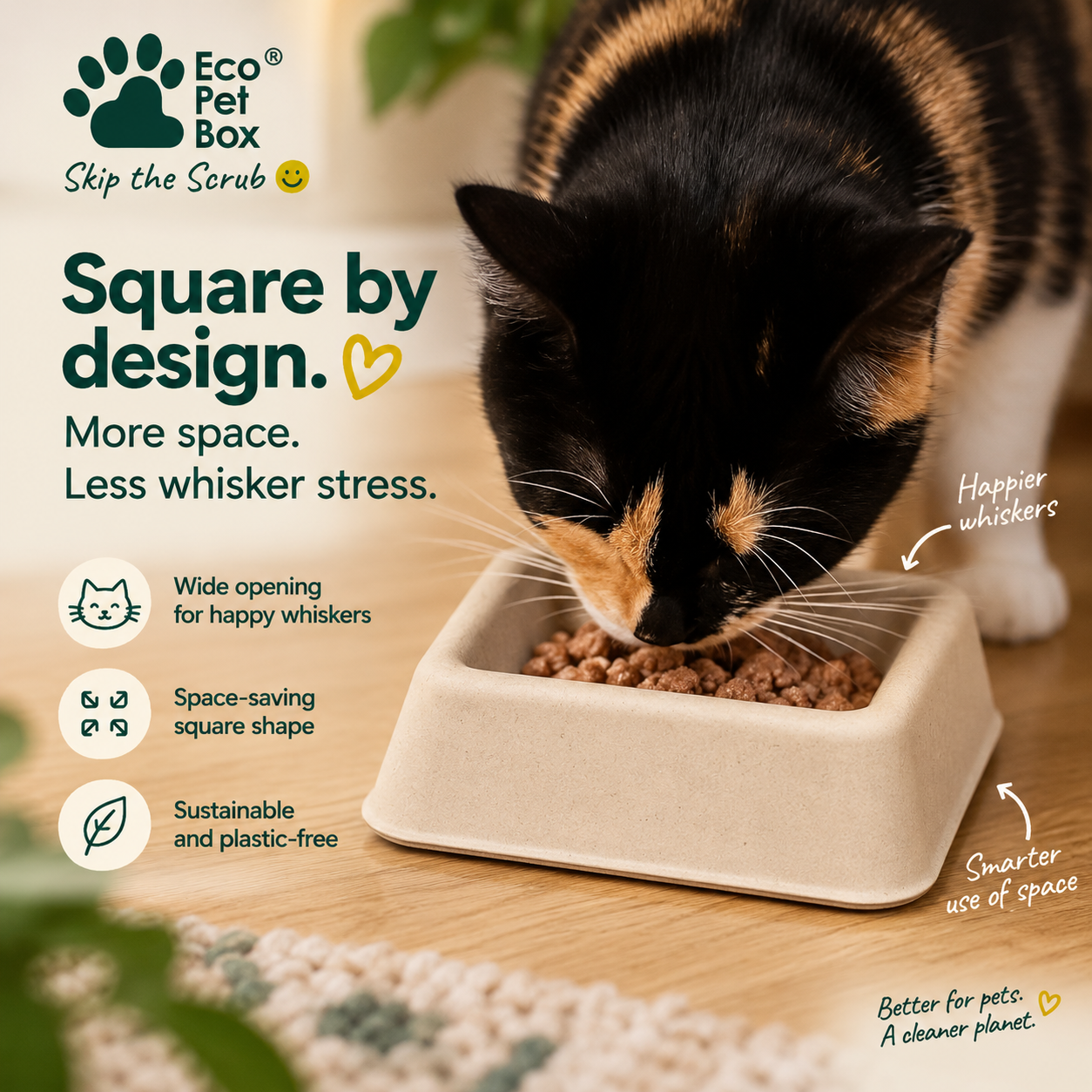
Whiskers (vibrissae) are touch organs wired straight into the nervous system. When they brush repeatedly against the curved inner walls of a deep, narrow bowl, some cats get visibly uncomfortable — they paw food onto the floor, eat in short bursts, walk away from a full bowl or seem fussy about the food itself. Vets and behaviour writers call this whisker fatigue or whisker stress; the practical fix everyone agrees on is a wider, shallower bowl.
A square opening gives more clear width at whisker height than a round bowl of the same capacity, and our low, straight walls keep the rim away from the cheeks. The cat eats head-down in one relaxed session instead of dipping in and pulling back. Flat-faced breeds — Persians, Exotics, British Shorthairs — benefit the most.
Easier to handle with limited mobility or arthritis
A square rim gives you two flat sides to grip, so the bowl can be lifted with a flat hand or between forearm and palm — no pinching, no hooking fingers under a slippery curved edge. That is a real difference for anyone with arthritis, reduced grip strength, tremor, or a wheelchair user reaching down to floor level. The bowl is also light: moulded plant fibre weighs a fraction of ceramic or steel, so a full bowl of water is far easier to carry.
And because the bowl is disposable, feeding stops involving the sink. There is no bending over a basin, no scrubbing, no scalding rinse water, no heavy wet ceramic to lift. Used bowl out, fresh bowl in — the whole task takes seconds, standing or seated. It is the same reason our trays are used by people with mobility restrictions: the job is redesigned, not just made slightly lighter.
Made of moulded plant fibre, not plastic
The shape only works because of the material. Moulded recycled paper and plant fibre can be pressed into crisp corners and a rigid flat base — and it's smooth and non-porous, so it doesn't build the micro-scratches that make plastic bowls a known trigger for feline chin acne. When the bowl has done its job, it biodegrades instead of sitting in landfill for decades.
Square EcoPetBox bowl vs standard round bowl
The practical differences owners, travellers and clinics actually notice.
| Factor | Square EcoPetBox bowl | Round plastic bowl |
|---|---|---|
| Space used on a shelf or in a cage | Fits flush into corners, no dead gaps | Wastes the corners around the circle |
| Stability under a paw | Wide flat base, resists tipping and spinning | Narrow foot rocks and slides |
| Whisker clearance at eating height | Wide opening, low straight walls | Curved walls press on whiskers |
| Handling with arthritis or weak grip | Flat sides to grip, very light, no washing | Slippery curve, heavier, needs scrubbing |
| Hygiene between pets or patients | Fresh bowl each time — no cross-contamination | Shared bowl, depends on the wash |
| End-of-life | General waste or home compost, biodegrades | Landfill for decades |
Why square wins — at a glance
- More capacity in a smaller footprint
- Wide flat base resists tipping and sliding
- Sits flush in cages, carriers and camper cupboards
- Wider opening means less whisker contact
- Flat sides are easier to grip with sore hands
- Light enough to carry full, without bending to a sink
- Single use — no cross-contamination between pets
- Plant fibre, plastic-free, biodegradable
Frequently asked questions
Why are EcoPetBox pet bowls square instead of round?
Because a square outline uses space better, sits flush in cages and carriers, resists tipping thanks to its wide flat base, and gives a cat's whiskers more clear width at eating height. Round is a manufacturing habit, not a benefit for the animal.
Read the full articleDo square bowls really reduce whisker stress?
A wider, shallower opening is the standard advice for cats that seem uncomfortable eating, paw food out of the bowl or eat in short bursts. A square opening gives more clear width at whisker height than a round bowl of the same capacity, so the cheeks and whiskers stay clear of the rim.
Read the full articleAre they suitable for veterinary clinics and shelters?
Yes — they're widely used in both. A square bowl pushes into the corner of a cage and leaves the patient more usable floor, and because each bowl is single use there's no cross-contamination between animals and no washing-up queue.
Read the full articleAre they easier to use for someone with arthritis or limited mobility?
Yes. The flat sides can be gripped with a flat hand instead of pinched, the moulded fibre weighs a fraction of ceramic, and there is no washing at all — used bowl out, fresh bowl in, which can be done seated.
Read the full articleHow do I dispose of a used bowl?
Into general household waste or home compost. Don't put it in paper recycling — it has been in contact with food, so it shouldn't be recycled any further.
Read the full articleRelated articles
 Related articles
Not ready to enquire yet? These may answer your question first.
July 23, 2026

Disposable vs. ceramic cat bowls: which is better for your cat's health?
Read the full article: Disposable vs. ceramic cat bowls: which is better for your cat's health?July 7, 2026

Is EcoPetBox good for travel, RV, Airbnb & temporary use?
Read the full article: Is EcoPetBox good for travel, RV, Airbnb & temporary use?July 2, 2026
Disposable litter boxes for vet clinics and post-surgery recovery
Read the full article: Disposable litter boxes for vet clinics and post-surgery recoverySee the square bowls
Plastic-free moulded fibre bowls that fit corners, stay put, and keep whiskers happy — at home, on the road or in the clinic.