Sustainability
Built so the planet doesn't pay for our pets.
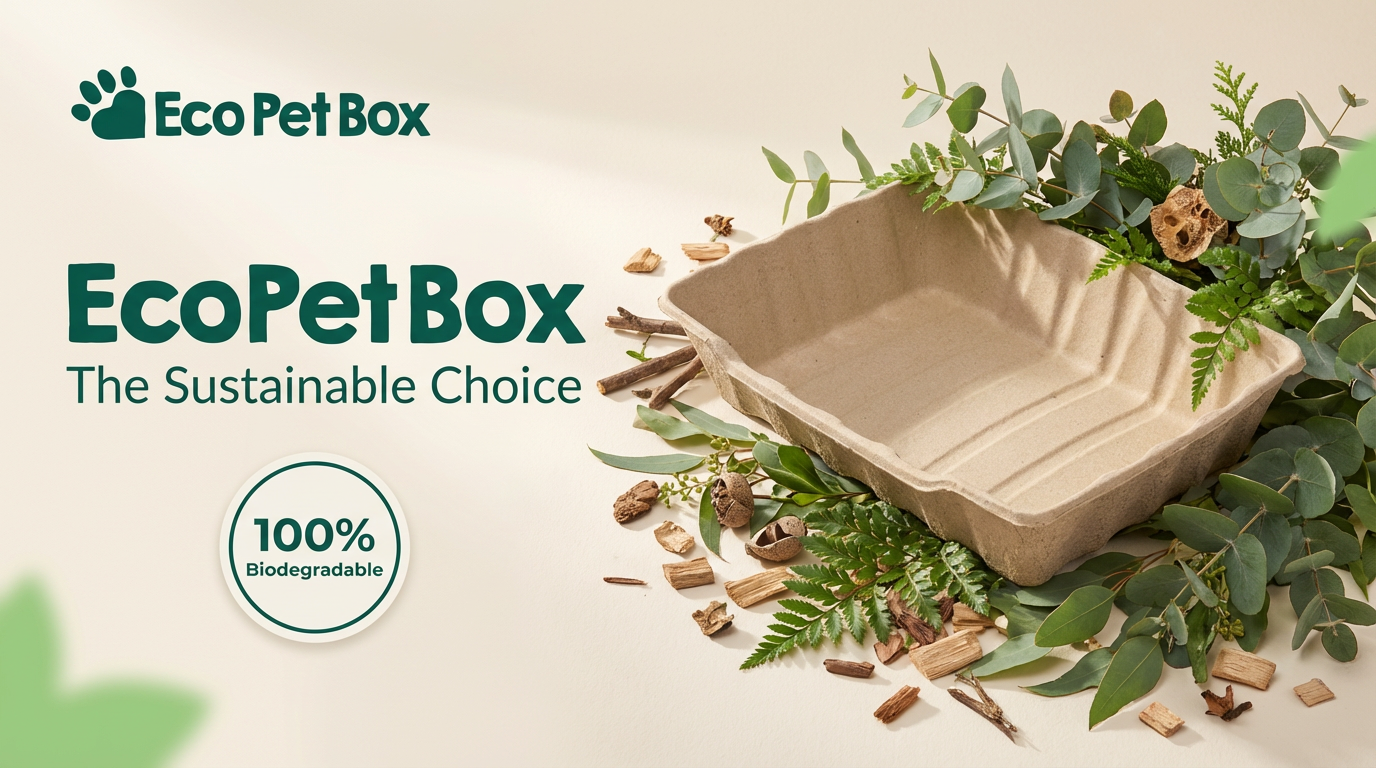
Every EcoPetBox tray, bowl, scoop and bag is designed to disappear — cleanly, naturally, and quickly — back into the earth it came from. So owners get more freedom from plastic, waste and guilt.
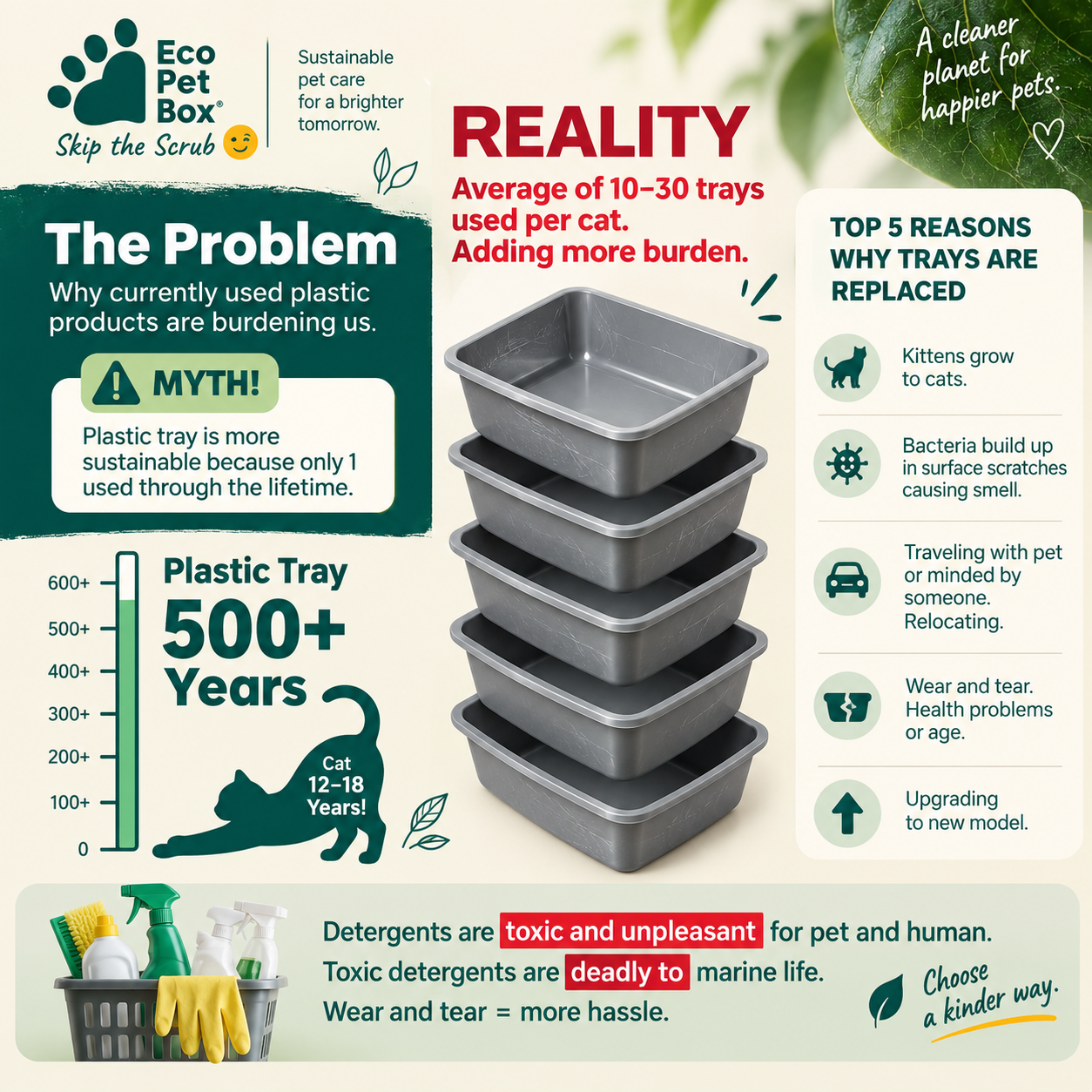
The myth
"A plastic tray lasts a lifetime."
In reality, the average cat owner replaces a plastic tray 10–30 times across a single cat's life — because of bacteria in surface scratches, wear and tear, smell, travel, or simply moving home. Each one then sits in landfill for 500+ years.
The reality
A cleaner system, end to end.
EcoPetBox trays, bowls, scoops and all-in-one kits fully biodegrade in 3–6 months. Our litters are all biodegradable too: wood and hay, wood only, and sugarcane and bamboo mix. No detergents, no wash water, no chemicals — and PFAS free — for the cat, the owner, and the waterways downstream.
500+ yrs
Plastic tray to degrade
3–6 mo
EcoPetBox to fully biodegrade
0 L
Wash water per year
600 000 L
water saved per 1,000 households per year
The numbers
97% less CO₂ than any plastic alternative.
EcoPetBox is 100% recycled paper — zero plastic, zero electronics, zero PFAS (Intertek tested). Manufacturing produces 97% less CO₂ than any plastic litter tray, automatic or otherwise. Fully biodegrades in 3–6 months.
vs. automatic litter boxes
Plastic. Electronics. E-waste in 3–5 years.
Automatic litter boxes are marketed as convenience. What they leave behind is 2–5 kg of ABS plastic housing, circuit boards, motors and sensors — classified as hazardous e-waste once they break. Only 22% of global e-waste is formally recycled; the rest leaches lead, cadmium and mercury into groundwater for centuries.
2–5 kg
ABS plastic per automatic box
3–5 yrs
Average lifespan before failure
24/7
Mains electricity consumed
vs. disposable pee pads
Plastic backing, SAP gel, landfill for 450 years.
Disposable pee pads combine plastic backing, plastic fibres and superabsorbent polymer (SAP) gel — none of which biodegrade. A pack-a-week habit generates hundreds of pads per household per year, all going to landfill. Reusable fabric mats solve the waste problem only by adding another: washing urine-saturated fabric through your household machine.
| Category | Disposable pad | Reusable fabric mat | EcoPetBox tray |
|---|---|---|---|
| End-of-life | Landfill ~450 years | Synthetic — non-biodegradable | Fully biodegrades in 3–6 months |
| Materials | Plastic + SAP polymer | Plastic fibres + coating | 100% recycled cardboard |
| PFAS / chemicals | Polymer gel, attractants | Synthetic waterproofing | Zero — Intertek certified |
| Water footprint | None — but disposable | Weekly machine wash | Zero wash water |
Footprint comparison
EcoPetBox vs. plastic litter tray.
| Criteria | EcoPetBox | Plastic tray |
|---|---|---|
| Renewability | Very good | Very poor |
| Manufacturing footprint | Low | High |
| End-of-life | Fully biodegrades 3–6 months | Landfill 500+ yrs |
| Chemicals required to clean | None | Detergents & disinfectants |
| Bacterial build-up risk | None — fresh each time | High — scratches harbour bacteria |
A small switch on your shelf. A big shift for the planet.
Contact usCompliance & certifications
Third-party tested. Retail-ready.
EcoPetBox trays are independently audited and lab-tested against the standards buyers and regulators ask for. Full test reports and certificates are available to verified retail and distribution partners on request.
FSC® Chain of Custody certified
Manufactured under a Bureau Veritas–audited FSC Chain of Custody scheme covering FSC 100%, FSC Mix and FSC Recycled fibre. Renewable, traceable material — never virgin plastic.
PFAS-free
Independently tested by Intertek against EN 17681-1 for perfluoroalkyl and polyfluoroalkyl substances. PFOS, PFOA and related compounds: not detected. Total fluorine below the 20 mg/kg screening threshold.
FDA food-contact tested
Molded fibre tested by TÜV Rheinland to US FDA 21 CFR 176.170 (paper and paperboard in contact with aqueous and fatty foods). Result: Pass.
RoHS compliant
Tested by TÜV Rheinland to Directive 2011/65/EU as amended by (EU) 2015/863. Lead, cadmium, mercury, hexavalent chromium, PBBs, PBDEs and the four regulated phthalates: not detected.
EU Packaging & Packaging Waste compliant
Meets the heavy-metal sum limits of Directive 94/62/EC and the US Toxics in Packaging Clearing House (TPCH) model. Made from 100% recycled paper fibre.
Halogen-free
Bromine, fluorine and iodine content: not detected (EN 14582). No halogenated flame retardants, no PFAS coatings, no chlorinated bleaches on the finished tray.
Registered EU trademark & design
EcoPetBox / ECO PET BOX is a registered trademark in the European Union and the United States (USPTO Principal Register). Our molded-fibre litter tray is a Registered Community Design at EUIPO and a Registered Design at the UK IPO, both protected through 2029. Retail-safe IP for distributor and private-label partners.
Global manufacturing footprint
Production across Estonia, Thailand, China, Mexico and Poland — dual-source resilience, shorter lead times to EU and North American DCs, and consistent audited quality standards.
Testing partners include TÜV Rheinland, Intertek and Bureau Veritas. Certificates, registration numbers and test report references are shared under NDA with qualified B2B partners.
Life Cycle Assessment · June 2026
The numbers, verified.
In June 2026 we published a full Life Cycle Assessment of the EcoPetBox molded-fibre litter tray and food & water bowl, prepared using recognised lifecycle analysis methodology. It covers raw materials, manufacturing energy, transport, use and end-of-life — the same framework used by leading food and packaging brands for their independent climate claims.
0.0525
kgCO₂e per tray — factory gate
0.1262
kgCO₂e delivered to the EU (cradle-to-customer)
~97%
less carbon than a plastic litter tray
~9×
lower carbon than a standard pee pad (single use)
98.7%
of manufacturing carbon is process electricity
2–4 mo
to biodegrade when composted (under 1 yr in landfill)
Where the carbon comes from
98.7% of manufacturing carbon is process electricity (pulping, forming, drying, hot-pressing, cutting). Local transport contributes 1.3%. Water use is under 0.1% — the same 10,000 L are filtered and reused across 25–30 batches. Raw material impact is near zero: every fibre comes from a waste stream (old corrugated cardboard, post-industrial scrap, waste-paper flakes). No trees are cut for EcoPetBox.
End of life
Recycle, compost, or biodegrade naturally: under 1 year in landfill, 2–4 months when composted. Zero plastic content, PFAS not detected (Intertek EN 17681-1), FDA 21 CFR 176.170 pass for food/water contact, and FSC Chain of Custody audited by Bureau Veritas.
Certifications FAQ
Quick answers on testing, compliance and IP.
The most common questions we get from buyers, distributors and private-label partners about how EcoPetBox trays are tested and protected.
Are EcoPetBox products certified and third-party tested?
Yes. Our molded-fibre trays are independently tested and certified by TÜV Rheinland, Intertek and Bureau Veritas against FDA 21 CFR 176.170 (food-contact), EN 17681-1 (PFAS), RoHS 2011/65/EU as amended by (EU) 2015/863, EN 14582 (halogens), FSC Chain of Custody, and EU Directive 94/62/EC on packaging waste.
Is EcoPetBox really PFAS-free?
Yes. PFOS, PFOA and related perfluoroalkyl compounds were not detected in independent Intertek testing to EN 17681-1. Total fluorine sits below the 20 mg/kg screening threshold — there are no PFAS coatings on the finished tray.
Are the trays safe for food and water contact?
Yes. The molded fibre passed TÜV Rheinland testing to US FDA 21 CFR 176.170, covering paper and paperboard in contact with aqueous and fatty foods. That is the same standard used for takeaway food packaging.
What about heavy metals and restricted substances?
Lead, cadmium, mercury, hexavalent chromium, PBBs, PBDEs and the four regulated phthalates were not detected in RoHS testing. The trays also meet the heavy-metal sum limits of EU Directive 94/62/EC and the US TPCH model on packaging.
Is the brand and product design legally protected?
Yes. EcoPetBox / ECO PET BOX is a registered trademark in the European Union and on the USPTO Principal Register in the United States. Our molded-fibre litter tray is a Registered Community Design at EUIPO and a Registered Design at the UK IPO, both protected through 2029 — retail-safe IP for distributor and private-label partners.
How do partners access certificates and test reports?
Full certificates, registration numbers and test report references are shared under NDA with qualified retail and distribution partners. Email partner@ecopetbox.com and we'll send the compliance pack for your market.