Sostenibilità
Costruito in modo che il pianeta non paghi per i nostri animali domestici.
Ogni vaschetta, ciotola, paletta e sacchetto EcoPetBox è progettato per scomparire — in modo pulito, naturale e rapido — tornando nella terra da cui proviene. Così i proprietari ottengono più libertà dalla plastica, dagli sprechi e dal senso di colpa.
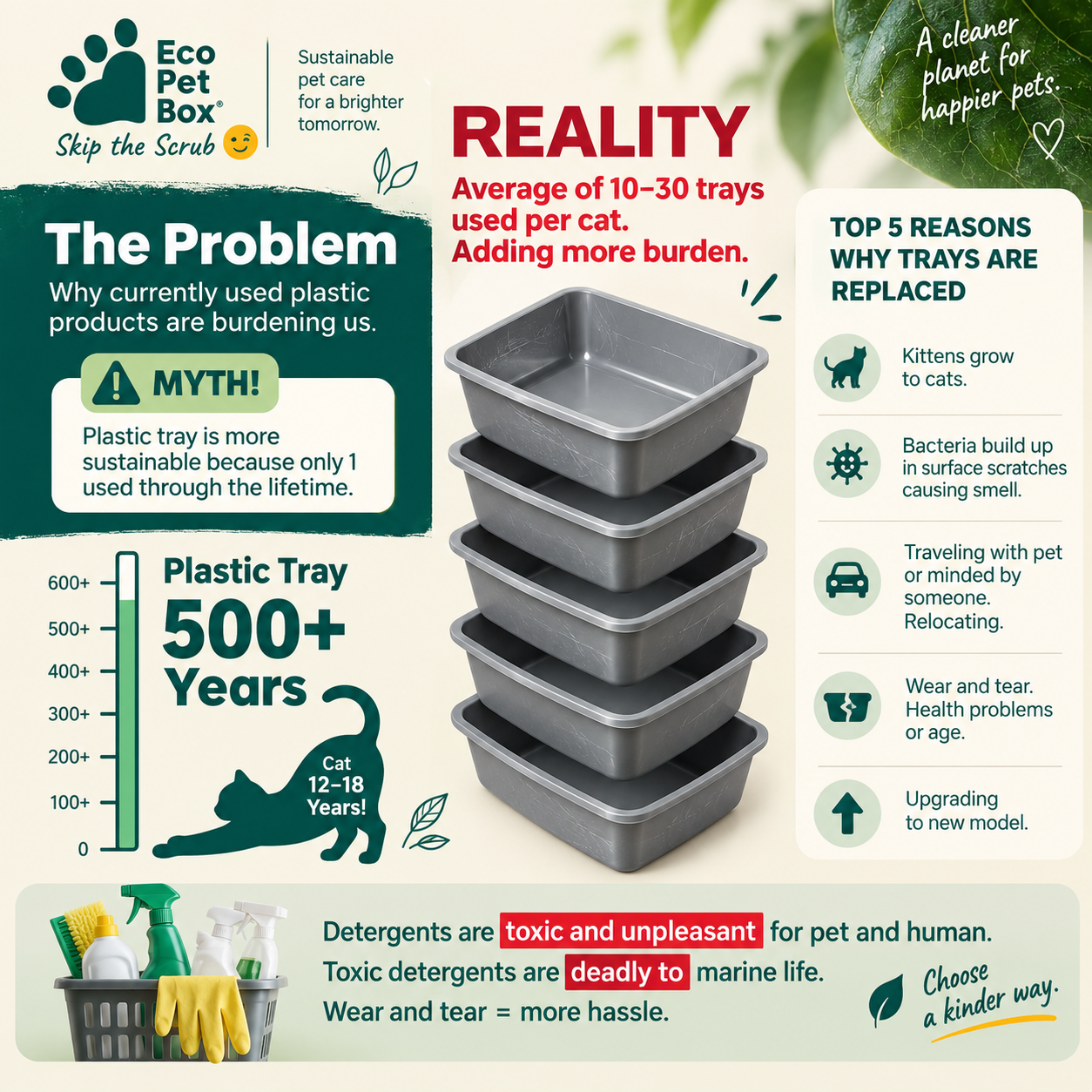
Il mito
"Una vaschetta di plastica dura una vita."
In realtà, il proprietario medio di gatti sostituisce una vaschetta di plastica 10–30 volte nell'arco della vita di un singolo gatto — a causa di batteri nei graffi superficiali, usura, cattivo odore, viaggi o semplicemente un trasloco. Ognuna di esse resta poi in discarica per oltre 500 anni.
La realtà
Un sistema più pulito, dall'inizio alla fine.
Le lettiere, ciotole, palette e kit completi EcoPetBox si biodegradano completamente in 3–6 mesi. Le nostre lettiere sono tutte biodegradabili: legno e fieno, solo legno, e una miscela di canna da zucchero e bambù. Niente detergenti, niente acqua di lavaggio, niente prodotti chimici — e senza PFAS — per il gatto, il proprietario e i corsi d'acqua a valle.
500+ anni
Tempo di degrado di una vaschetta di plastica
3–6 mesi
EcoPetBox per biodegradarsi completamente
0 L
Acqua di lavaggio all'anno
600 000 L
acqua risparmiata per 1.000 famiglie all'anno
I numeri
97% in meno di CO₂ rispetto a qualsiasi alternativa in plastica.
EcoPetBox è carta riciclata al 100% — zero plastica, zero elettronica, zero PFAS (testato da Intertek). La produzione genera il 97% in meno di CO₂ rispetto a qualsiasi vaschetta di plastica, automatica o meno. Si biodegrada completamente in 3–6 mesi.
vs. lettiere automatiche
Plastica. Elettronica. Rifiuti elettronici in 3-5 anni.
Le lettiere automatiche sono commercializzate come comode. Ciò che lasciano dietro di sé sono 2-5 kg di alloggiamento in plastica ABS, circuiti stampati, motori e sensori — classificati come rifiuti elettronici pericolosi una volta rotti. Solo il 22% dei rifiuti elettronici globali viene formalmente riciclato; il resto rilascia piombo, cadmio e mercurio nelle falde acquifere per secoli.
2–5 kg
Plastica ABS per vaschetta automatica
3–5 anni
Durata media prima del guasto
24/7
Elettricità di rete consumata
vs. tappetini assorbenti usa e getta
Supporto in plastica, gel SAP, discarica per 450 anni.
I tappetini assorbenti usa e getta combinano supporto in plastica, fibre di plastica e gel di polimero superassorbente (SAP) — nessuno dei quali si biodegrada. Un'abitudine di un pacchetto a settimana genera centinaia di tappetini per famiglia all'anno, tutti destinati alla discarica. I tappetini in tessuto riutilizzabili risolvono il problema dei rifiuti solo aggiungendone un altro: lavare il tessuto saturo di urina nella lavatrice domestica.
| Categoria | Tappetino usa e getta | Tappetino in tessuto riutilizzabile | Vaschetta EcoPetBox |
|---|---|---|---|
| Fine vita | Discarica ~450 anni | Sintetico — non biodegradabile | Si biodegrada completamente in 3–6 mesi |
| Materiali | Plastica + polimero SAP | Fibre di plastica + rivestimento | Cartone riciclato al 100% |
| PFAS / sostanze chimiche | Gel polimerico, attrattivi | Impermeabilizzazione sintetica | Zero — certificato Intertek |
| Impronta idrica | Nessuna — ma usa e getta | Lavaggio settimanale in lavatrice | Zero acqua di lavaggio |
Confronto dell'impronta
EcoPetBox vs. vaschetta di plastica.
| Criteri | EcoPetBox | Vaschetta di plastica |
|---|---|---|
| Rinnovabilità | Molto buono | Molto scarso |
| Impronta di fabbricazione | Bassa | Alta |
| Fine vita | Si biodegrada completamente in 3–6 mesi | Discarica 500+ anni |
| Sostanze chimiche richieste per la pulizia | Nessuna | Detergenti e disinfettanti |
| Rischio di accumulo batterico | Nessuno — fresco ogni volta | Alto — i graffi ospitano batteri |
Un piccolo cambiamento sul tuo scaffale. Un grande cambiamento per il pianeta.
ContattaciCompliance & certifications
Third-party tested. Retail-ready.
EcoPetBox trays are independently audited and lab-tested against the standards buyers and regulators ask for. Full test reports and certificates are available to verified retail and distribution partners on request.
FSC® Chain of Custody certified
Manufactured under a Bureau Veritas–audited FSC Chain of Custody scheme covering FSC 100%, FSC Mix and FSC Recycled fibre. Renewable, traceable material — never virgin plastic.
PFAS-free
Independently tested by Intertek against EN 17681-1 for perfluoroalkyl and polyfluoroalkyl substances. PFOS, PFOA and related compounds: not detected. Total fluorine below the 20 mg/kg screening threshold.
FDA food-contact tested
Molded fibre tested by TÜV Rheinland to US FDA 21 CFR 176.170 (paper and paperboard in contact with aqueous and fatty foods). Result: Pass.
RoHS compliant
Tested by TÜV Rheinland to Directive 2011/65/EU as amended by (EU) 2015/863. Lead, cadmium, mercury, hexavalent chromium, PBBs, PBDEs and the four regulated phthalates: not detected.
EU Packaging & Packaging Waste compliant
Meets the heavy-metal sum limits of Directive 94/62/EC and the US Toxics in Packaging Clearing House (TPCH) model. Made from 100% recycled paper fibre.
Halogen-free
Bromine, fluorine and iodine content: not detected (EN 14582). No halogenated flame retardants, no PFAS coatings, no chlorinated bleaches on the finished tray.
Registered EU trademark & design
EcoPetBox / ECO PET BOX is a registered trademark in the European Union and the United States (USPTO Principal Register). Our molded-fibre litter tray is a Registered Community Design at EUIPO and a Registered Design at the UK IPO, both protected through 2029. Retail-safe IP for distributor and private-label partners.
Global manufacturing footprint
Production across Estonia, Thailand, China, Mexico and Poland — dual-source resilience, shorter lead times to EU and North American DCs, and consistent audited quality standards.
Testing partners include TÜV Rheinland, Intertek and Bureau Veritas. Certificates, registration numbers and test report references are shared under NDA with qualified B2B partners.
Life Cycle Assessment · June 2026
The numbers, verified.
In June 2026 we published a full Life Cycle Assessment of the EcoPetBox molded-fibre litter tray and food & water bowl, prepared using recognised lifecycle analysis methodology. It covers raw materials, manufacturing energy, transport, use and end-of-life — the same framework used by leading food and packaging brands for their independent climate claims.
0.0525
kgCO₂e per tray — factory gate
0.1262
kgCO₂e delivered to the EU (cradle-to-customer)
~97%
less carbon than a plastic litter tray
~9×
lower carbon than a standard pee pad (single use)
98.7%
of manufacturing carbon is process electricity
2–4 mo
to biodegrade when composted (under 1 yr in landfill)
Where the carbon comes from
98.7% of manufacturing carbon is process electricity (pulping, forming, drying, hot-pressing, cutting). Local transport contributes 1.3%. Water use is under 0.1% — the same 10,000 L are filtered and reused across 25–30 batches. Raw material impact is near zero: every fibre comes from a waste stream (old corrugated cardboard, post-industrial scrap, waste-paper flakes). No trees are cut for EcoPetBox.
End of life
Recycle, compost, or biodegrade naturally: under 1 year in landfill, 2–4 months when composted. Zero plastic content, PFAS not detected (Intertek EN 17681-1), FDA 21 CFR 176.170 pass for food/water contact, and FSC Chain of Custody audited by Bureau Veritas.
Certifications FAQ
Quick answers on testing, compliance and IP.
The most common questions we get from buyers, distributors and private-label partners about how EcoPetBox trays are tested and protected.
Are EcoPetBox products certified and third-party tested?
Yes. Our molded-fibre trays are independently tested and certified by TÜV Rheinland, Intertek and Bureau Veritas against FDA 21 CFR 176.170 (food-contact), EN 17681-1 (PFAS), RoHS 2011/65/EU as amended by (EU) 2015/863, EN 14582 (halogens), FSC Chain of Custody, and EU Directive 94/62/EC on packaging waste.
Is EcoPetBox really PFAS-free?
Yes. PFOS, PFOA and related perfluoroalkyl compounds were not detected in independent Intertek testing to EN 17681-1. Total fluorine sits below the 20 mg/kg screening threshold — there are no PFAS coatings on the finished tray.
Are the trays safe for food and water contact?
Yes. The molded fibre passed TÜV Rheinland testing to US FDA 21 CFR 176.170, covering paper and paperboard in contact with aqueous and fatty foods. That is the same standard used for takeaway food packaging.
What about heavy metals and restricted substances?
Lead, cadmium, mercury, hexavalent chromium, PBBs, PBDEs and the four regulated phthalates were not detected in RoHS testing. The trays also meet the heavy-metal sum limits of EU Directive 94/62/EC and the US TPCH model on packaging.
Is the brand and product design legally protected?
Yes. EcoPetBox / ECO PET BOX is a registered trademark in the European Union and on the USPTO Principal Register in the United States. Our molded-fibre litter tray is a Registered Community Design at EUIPO and a Registered Design at the UK IPO, both protected through 2029 — retail-safe IP for distributor and private-label partners.
How do partners access certificates and test reports?
Full certificates, registration numbers and test report references are shared under NDA with qualified retail and distribution partners. Email partner@ecopetbox.com and we'll send the compliance pack for your market.