Durabilité
Conçu pour que la planète ne paie pas pour nos animaux de compagnie.
Chaque bac, gamelle, pelle et sac EcoPetBox est conçu pour disparaître — proprement, naturellement et rapidement — dans la terre dont il est issu. De quoi offrir aux propriétaires plus de liberté vis-à-vis du plastique, des déchets et de la culpabilité.
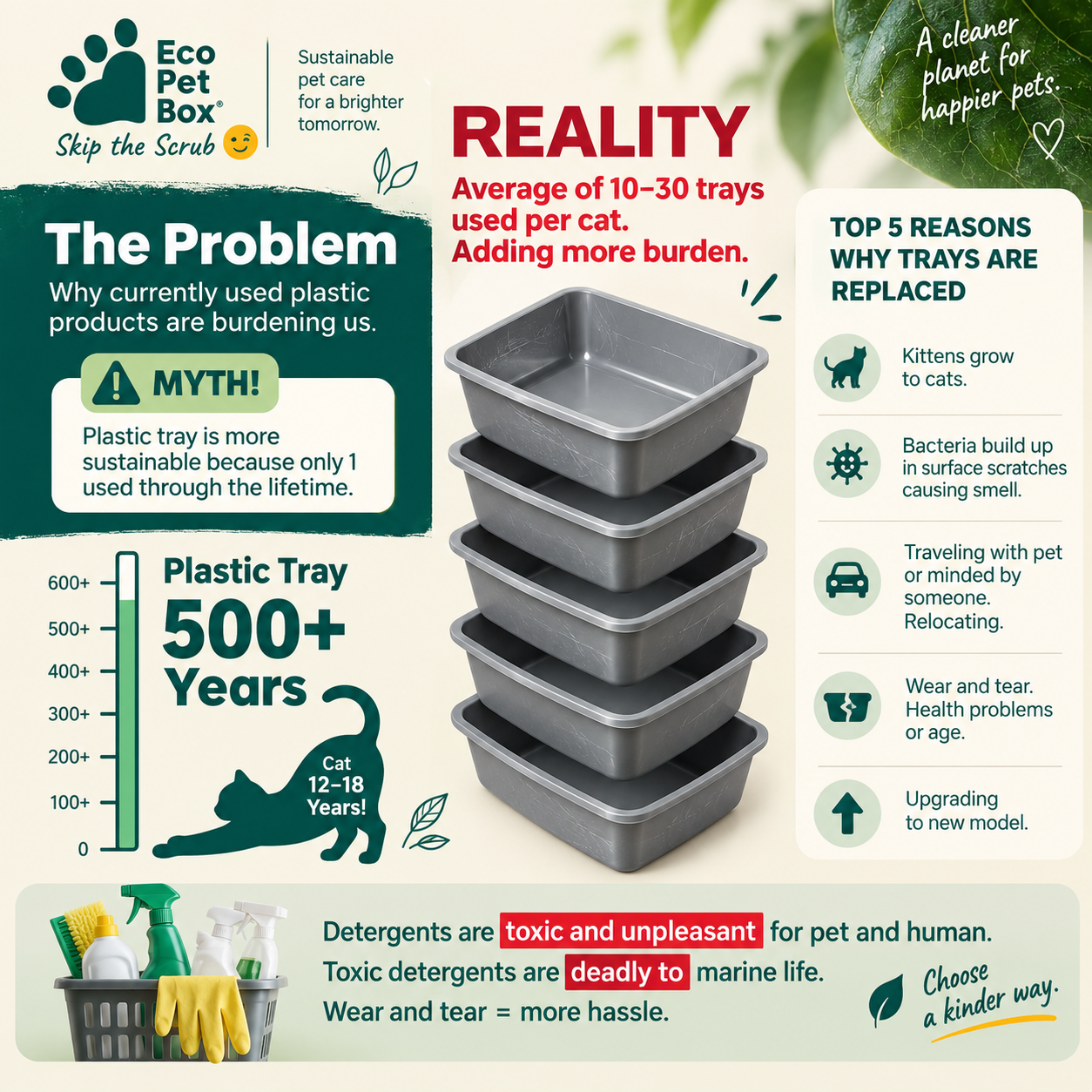
Le mythe
« Un bac en plastique dure toute une vie. »
En réalité, le propriétaire de chat moyen remplace un bac en plastique 10 à 30 fois au cours de la vie d'un seul chat — à cause des bactéries logées dans les rayures, de l'usure, des odeurs, des déplacements ou simplement d'un déménagement. Chaque bac finit ensuite en décharge pour plus de 500 ans.
La réalité
Un système plus propre, de bout en bout.
Les bacs, gamelles, pelles et kits tout-en-un EcoPetBox se biodégradent entièrement en 3 à 6 mois. Nos litières le sont aussi : bois et foin, bois seul, ou mélange de canne à sucre et de bambou. Pas de détergents, pas d'eau de lavage, pas de produits chimiques — et sans PFAS — pour le chat, le propriétaire et les cours d'eau en aval.
500+ ans
Dégradation du bac en plastique
3–6 mois
Biodégradation complète d'EcoPetBox
0 L
Eau de lavage par an
600 000 L
d'eau économisée par 1 000 foyers par an
Les chiffres
97 % moins de CO₂ que toute alternative en plastique.
EcoPetBox est fait de papier 100 % recyclé — zéro plastique, zéro électronique, zéro PFAS (testé par Intertek). Sa fabrication produit 97 % de CO₂ en moins que n'importe quel bac en plastique, automatique ou non. Entièrement biodégradable en 3 à 6 mois.
vs. bacs à litière automatiques
Plastique. Électronique. Déchets électroniques en 3 à 5 ans.
Les bacs à litière automatiques sont vendus comme une solution de confort. Ce qu'ils laissent derrière eux, ce sont 2 à 5 kg de boîtier en plastique ABS, de circuits imprimés, de moteurs et de capteurs — classés comme déchets électroniques dangereux dès qu'ils tombent en panne. Seuls 22 % des déchets électroniques mondiaux sont officiellement recyclés ; le reste libère plomb, cadmium et mercure dans les eaux souterraines pendant des siècles.
2–5 kg
Plastique ABS par bac automatique
3–5 ans
Durée de vie moyenne avant panne
24/7
Électricité secteur consommée
vs. tapis de propreté jetables
Support plastique, gel SAP, décharge pendant 450 ans.
Les tapis de propreté jetables combinent un support plastique, des fibres plastiques et un gel polymère superabsorbant (SAP) — rien de tout cela n'est biodégradable. À raison d'un paquet par semaine, cela représente des centaines de tapis par foyer et par an, tous destinés à la décharge. Les tapis en tissu réutilisables ne résolvent le problème des déchets qu'en en créant un autre : laver du tissu saturé d'urine dans votre machine à laver.
| Catégorie | Tapis jetable | Tapis en tissu réutilisable | Bac EcoPetBox |
|---|---|---|---|
| Fin de vie | Décharge ~450 ans | Synthétique — non biodégradable | Biodégradable entièrement en 3–6 mois |
| Matériaux | Plastique + polymère SAP | Fibres plastiques + revêtement | Carton 100 % recyclé |
| PFAS / produits chimiques | Gel polymère, attractifs | Imperméabilisation synthétique | Zéro — certifié Intertek |
| Empreinte hydrique | Aucune — mais jetable | Lavage en machine hebdomadaire | Zéro eau de lavage |
Comparaison de l'empreinte
EcoPetBox vs. bac à litière en plastique.
| Critères | EcoPetBox | Bac en plastique |
|---|---|---|
| Renouvelabilité | Très bonne | Très mauvaise |
| Empreinte de fabrication | Faible | Élevée |
| Fin de vie | Biodégradable entièrement en 3–6 mois | Décharge 500+ ans |
| Produits chimiques nécessaires au récurage | Aucun | Détergents et désinfectants |
| Risque d'accumulation bactérienne | Aucun — frais à chaque fois | Élevé — les rayures abritent des bactéries |
Un petit geste sur votre étagère. Un grand pas pour la planète.
Contactez-nousCompliance & certifications
Third-party tested. Retail-ready.
EcoPetBox trays are independently audited and lab-tested against the standards buyers and regulators ask for. Full test reports and certificates are available to verified retail and distribution partners on request.
FSC® Chain of Custody certified
Manufactured under a Bureau Veritas–audited FSC Chain of Custody scheme covering FSC 100%, FSC Mix and FSC Recycled fibre. Renewable, traceable material — never virgin plastic.
PFAS-free
Independently tested by Intertek against EN 17681-1 for perfluoroalkyl and polyfluoroalkyl substances. PFOS, PFOA and related compounds: not detected. Total fluorine below the 20 mg/kg screening threshold.
FDA food-contact tested
Molded fibre tested by TÜV Rheinland to US FDA 21 CFR 176.170 (paper and paperboard in contact with aqueous and fatty foods). Result: Pass.
RoHS compliant
Tested by TÜV Rheinland to Directive 2011/65/EU as amended by (EU) 2015/863. Lead, cadmium, mercury, hexavalent chromium, PBBs, PBDEs and the four regulated phthalates: not detected.
EU Packaging & Packaging Waste compliant
Meets the heavy-metal sum limits of Directive 94/62/EC and the US Toxics in Packaging Clearing House (TPCH) model. Made from 100% recycled paper fibre.
Halogen-free
Bromine, fluorine and iodine content: not detected (EN 14582). No halogenated flame retardants, no PFAS coatings, no chlorinated bleaches on the finished tray.
Registered EU trademark & design
EcoPetBox / ECO PET BOX is a registered trademark in the European Union and the United States (USPTO Principal Register). Our molded-fibre litter tray is a Registered Community Design at EUIPO and a Registered Design at the UK IPO, both protected through 2029. Retail-safe IP for distributor and private-label partners.
Global manufacturing footprint
Production across Estonia, Thailand, China, Mexico and Poland — dual-source resilience, shorter lead times to EU and North American DCs, and consistent audited quality standards.
Testing partners include TÜV Rheinland, Intertek and Bureau Veritas. Certificates, registration numbers and test report references are shared under NDA with qualified B2B partners.
Life Cycle Assessment · June 2026
The numbers, verified.
In June 2026 we published a full Life Cycle Assessment of the EcoPetBox molded-fibre litter tray and food & water bowl, prepared using recognised lifecycle analysis methodology. It covers raw materials, manufacturing energy, transport, use and end-of-life — the same framework used by leading food and packaging brands for their independent climate claims.
0.0525
kgCO₂e per tray — factory gate
0.1262
kgCO₂e delivered to the EU (cradle-to-customer)
~97%
less carbon than a plastic litter tray
~9×
lower carbon than a standard pee pad (single use)
98.7%
of manufacturing carbon is process electricity
2–4 mo
to biodegrade when composted (under 1 yr in landfill)
Where the carbon comes from
98.7% of manufacturing carbon is process electricity (pulping, forming, drying, hot-pressing, cutting). Local transport contributes 1.3%. Water use is under 0.1% — the same 10,000 L are filtered and reused across 25–30 batches. Raw material impact is near zero: every fibre comes from a waste stream (old corrugated cardboard, post-industrial scrap, waste-paper flakes). No trees are cut for EcoPetBox.
End of life
Recycle, compost, or biodegrade naturally: under 1 year in landfill, 2–4 months when composted. Zero plastic content, PFAS not detected (Intertek EN 17681-1), FDA 21 CFR 176.170 pass for food/water contact, and FSC Chain of Custody audited by Bureau Veritas.
Certifications FAQ
Quick answers on testing, compliance and IP.
The most common questions we get from buyers, distributors and private-label partners about how EcoPetBox trays are tested and protected.
Are EcoPetBox products certified and third-party tested?
Yes. Our molded-fibre trays are independently tested and certified by TÜV Rheinland, Intertek and Bureau Veritas against FDA 21 CFR 176.170 (food-contact), EN 17681-1 (PFAS), RoHS 2011/65/EU as amended by (EU) 2015/863, EN 14582 (halogens), FSC Chain of Custody, and EU Directive 94/62/EC on packaging waste.
Is EcoPetBox really PFAS-free?
Yes. PFOS, PFOA and related perfluoroalkyl compounds were not detected in independent Intertek testing to EN 17681-1. Total fluorine sits below the 20 mg/kg screening threshold — there are no PFAS coatings on the finished tray.
Are the trays safe for food and water contact?
Yes. The molded fibre passed TÜV Rheinland testing to US FDA 21 CFR 176.170, covering paper and paperboard in contact with aqueous and fatty foods. That is the same standard used for takeaway food packaging.
What about heavy metals and restricted substances?
Lead, cadmium, mercury, hexavalent chromium, PBBs, PBDEs and the four regulated phthalates were not detected in RoHS testing. The trays also meet the heavy-metal sum limits of EU Directive 94/62/EC and the US TPCH model on packaging.
Is the brand and product design legally protected?
Yes. EcoPetBox / ECO PET BOX is a registered trademark in the European Union and on the USPTO Principal Register in the United States. Our molded-fibre litter tray is a Registered Community Design at EUIPO and a Registered Design at the UK IPO, both protected through 2029 — retail-safe IP for distributor and private-label partners.
How do partners access certificates and test reports?
Full certificates, registration numbers and test report references are shared under NDA with qualified retail and distribution partners. Email partner@ecopetbox.com and we'll send the compliance pack for your market.