Brand story
The Future Paper Napkin: Why Disposable Trays Will Replace Plastic Litter Tubs
For a while inside the team, EcoPetBox was called the future paper napkin. The parallel is not perfect — cats are not handkerchiefs — but the pattern behind it is. The reusable handkerchief has almost disappeared from everyday use because the paper tissue is more convenient, more hygienic, removes the chore of washing, and biodegrades. We believed the same four forces would eventually replace the plastic litter tub with a disposable, renewable alternative. This is the story behind that name and why it still shapes how we think about the product.
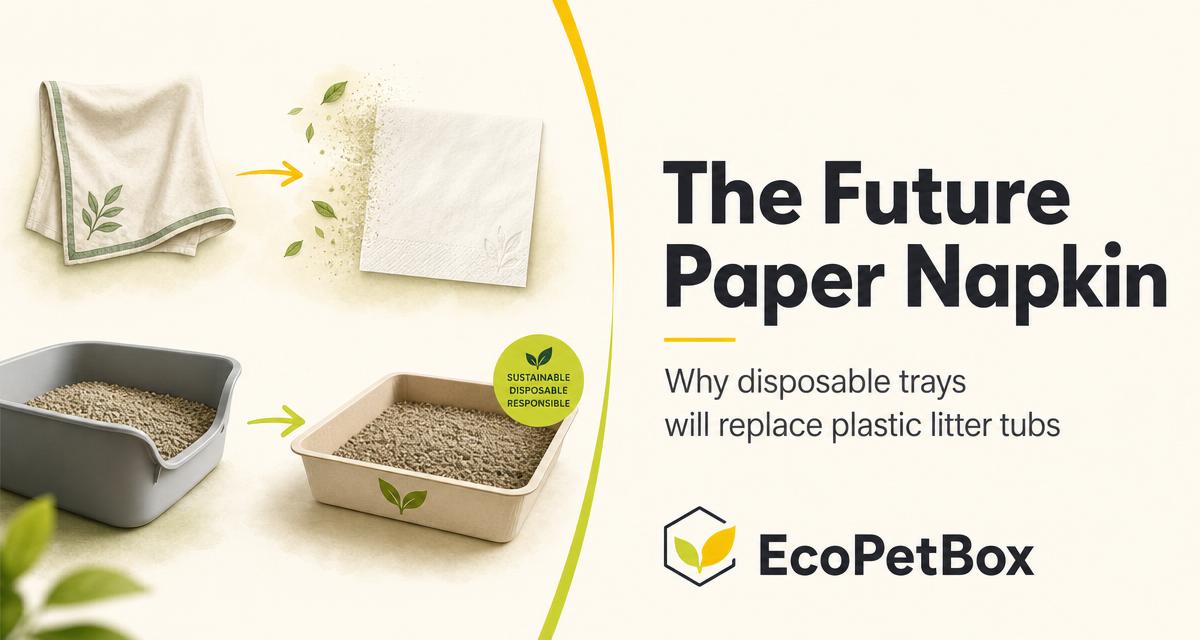
"We were not trying to make a slightly better plastic box. We were trying to make the plastic box optional, the way paper tissues made the handkerchief optional."
The handkerchief is gone. The paper tissue won.
A few generations ago, the handkerchief was a personal item. People owned it, carried it, used it, washed it, ironed it, and used it again. It was the standard. Today, outside of some formal or nostalgic contexts, it has almost disappeared. The paper tissue took over because it solved four real problems at once: it is convenient, it is more hygienic, it removes the need to wash something soiled, and it is fully biodegradable.
No one had to be convinced to switch on moral grounds. They switched because it was better in daily use. Sustainability was the bonus, not the compromise. That is the exact shift we wanted to create for cat litter trays.
Four reasons the paper tissue replaced the handkerchief
First, convenience. A tissue is always fresh, ready to use, and disappears when you are done. Second, hygiene. A single-use item does not carry yesterday's bacteria back into your pocket or hand. Third, no washing. The chore of cleaning and drying a soiled fabric square simply vanishes. Fourth, it biodegrades. A paper tissue breaks down naturally, whereas a used handkerchief still has to be laundered with energy, water and detergent.
Those four advantages are not about luxury. They are about removing friction from a daily task. When a product removes friction and is still responsible at end of life, reusable alternatives stop being competitive.
The same four forces are reshaping the litter box
A plastic litter tub is the handkerchief in this story. It is owned, used, soiled, scrubbed, dried, and used again. Over time it scratches, holds odour, and becomes a bacteria reservoir that no amount of bleach fully resets. The weekly scrub is the modern equivalent of washing a handkerchief — and most cat owners would happily stop doing it.
EcoPetBox is the paper tissue. It is convenient: open, use, replace. It is more hygienic: a fresh surface every cycle, no scratches trapping waste, no permanent smell. It removes washing entirely: zero litres of water, zero scrubbing, zero bleach. And it biodegrades: the moulded recycled-paper tray and natural litter break down in 3–6 months in household waste or home compost, rather than sitting in landfill for centuries.
Why the name stuck with us
We called the project the future paper napkin internally because it kept the team honest. It was a reminder that the goal was not a premium plastic box, a better coating, or a stronger scrubbing brush. The goal was a category shift. We wanted pet owners to stop thinking of the tray as a piece of household equipment they owned and maintained, and start thinking of it as a renewable, single-use item that simply gets replaced.
The name also made the business case clearer. Paper tissues are not a niche product. They became the default because they removed a chore and left no guilt behind. That is the same standard EcoPetBox has to meet: less work, more hygiene, and biodegradability built in.
What this means for cat owners today
For owners, the shift is practical. Changing the litter goes from a weekly deep-clean event to a one-minute replacement. The home smells better because the tray never has time to absorb ammonia into scratched plastic. Seniors, people with arthritis, and anyone with chemical sensitivities no longer need to wrestle with a heavy tub and harsh cleaners. And there is no plastic tray at the end of its life to dispose of in landfill.
The future paper napkin idea is not a marketing slogan. It is a design filter. Every product decision — the material, the shape, the end-of-life, the supply chain — is tested against the same question: does this make the plastic tub as optional as the handkerchief became?
Why disposable trays follow the same logic as paper tissues
- No scrubbing or washing — the tray is replaced, not cleaned
- Fresh surface every cycle, so odour and bacteria reset to zero
- More hygienic for the cat and everyone in the household
- Moulded recycled paper biodegrades in 3–6 months
- Works with every cat litter, so owners keep their preferred brand
- The plastic tub becomes optional, not permanent
Frequently asked questions
Why did you call EcoPetBox the future paper napkin?
Internally, it was a shorthand for a category shift. The paper tissue made the handkerchief optional by being more convenient, more hygienic, wash-free and biodegradable. We wanted the disposable litter tray to do the same thing to the plastic litter tub.
Read the full articleIs a disposable tray really as convenient as a paper tissue?
For the user, yes. Instead of scooping, scrubbing, drying and refilling a plastic tub, you lift out the old tray and drop in a new one. The total time to reset the litter box is under a minute, with no washing involved.
Read the full articleDoesn't a disposable tray create more waste?
Not when compared to the full lifecycle of plastic. A plastic tray is replaced many times across a cat's life and then sits in landfill for 500+ years. EcoPetBox trays biodegrade in 3–6 months in household waste or home compost. The trade-off is a small amount of renewable material against centuries of plastic.
How long does one EcoPetBox tray last?
Most households replace a tray every one to two weeks per cat. You can reuse trays that are still in good condition, extending use up to two months. The key is that the tray only needs to last until it is time for a genuinely fresh one.
Read the full articleIs the material safe for cats and homes?
Yes. The trays are made from PFAS-free moulded recycled paper, tested at Intertek. There are no plastic coatings, no harsh chemicals, and no micro-scratches that trap bacteria.
Read the full articleRelated articles
 Related articles
Not ready to enquire yet? These may answer your question first.
July 2, 2026
Our story: how EcoPetBox started
Read the full article: Our story: how EcoPetBox startedJuly 13, 2026
Pee pads vs washable pads vs EcoPetBox: what remains 10 years later?
Read the full article: Pee pads vs washable pads vs EcoPetBox: what remains 10 years later?July 7, 2026
Will my cat scratch through an EcoPetBox tray?
Read the full article: Will my cat scratch through an EcoPetBox tray?Try the future paper napkin for cats
Order a set of EcoPetBox disposable trays and see how quickly the plastic scrub becomes optional.