Sostenibilidad
Construido para que el planeta no pague por nuestras mascotas.
Cada bandeja, cuenco, pala y bolsa de EcoPetBox está diseñada para desaparecer, de forma limpia, natural y rápida, de vuelta a la tierra de donde provino. Así, los dueños obtienen más libertad de plástico, residuos y culpa.
El mito
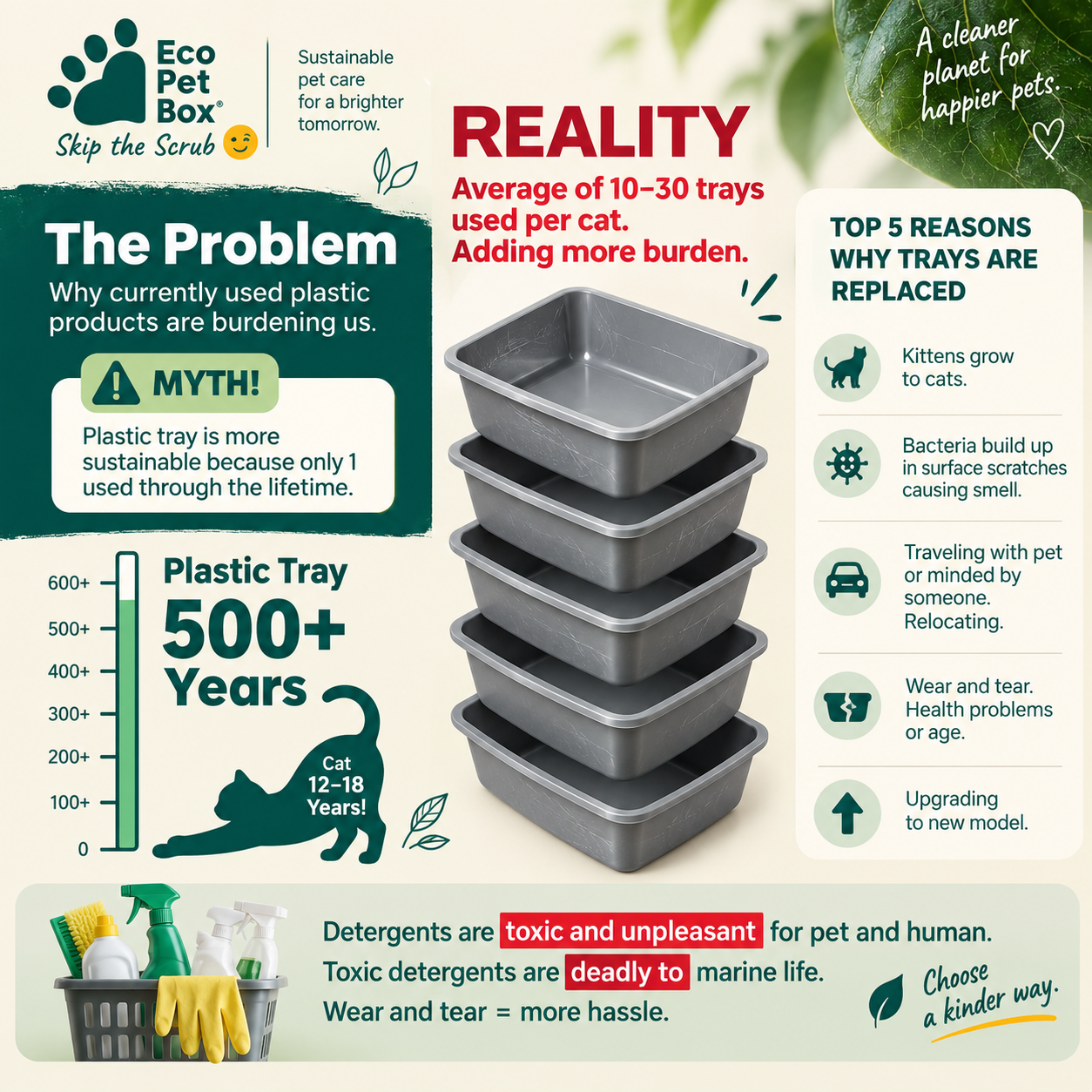
"Una bandeja de plástico dura toda la vida."
En realidad, el dueño promedio de un gato reemplaza una bandeja de plástico entre 10 y 30 veces a lo largo de la vida de un solo gato, debido a bacterias en los arañazos de la superficie, desgaste, olor, viajes o simplemente mudanzas. Cada una de ellas permanece en el vertedero durante más de 500 años.
La realidad
Un sistema más limpio, de principio a fin.
Las bandejas, tazones, palas y kits todo en uno de EcoPetBox se biodegradan completamente en 3–6 meses. Nuestras arenas también son biodegradables: madera y heno, solo madera, y una mezcla de caña de azúcar y bambú. Sin detergentes, sin agua de lavado, sin productos químicos, y libre de PFAS, para el gato, el dueño y las vías fluviales río abajo.
500+ años
Bandeja de plástico para degradarse
3–6 meses
EcoPetBox para biodegradarse completamente
0 L
Agua de lavado por año
600 000 L
agua ahorrada por 1.000 hogares al año
Los números
97% menos de CO₂ que cualquier alternativa de plástico.
EcoPetBox es papel 100% reciclado — cero plástico, cero electrónica, cero PFAS (probado por Intertek). La fabricación produce un 97% menos de CO₂ que cualquier bandeja de arena de plástico, automática o no. Se biodegrada completamente en 3-6 meses.
vs. cajas de arena automáticas
Plástico. Electrónica. Residuos electrónicos en 3-5 años.
Las cajas de arena automáticas se comercializan como comodidad. Lo que dejan atrás son 2-5 kg de carcasa de plástico ABS, placas de circuito, motores y sensores, clasificados como residuos electrónicos peligrosos una vez que se rompen. Solo el 22% de los residuos electrónicos globales se reciclan formalmente; el resto filtra plomo, cadmio y mercurio en las aguas subterráneas durante siglos.
2–5 kg
Plástico ABS por caja automática
3–5 años
Vida útil promedio antes de fallar
24/7
Electricidad de red consumida
vs. empapadores desechables
Respaldo de plástico, gel SAP, vertedero durante 450 años.
Los empapadores desechables combinan respaldo de plástico, fibras de plástico y gel de polímero superabsorbente (SAP), ninguno de los cuales se biodegrada. Un hábito de un paquete por semana genera cientos de empapadores por hogar al año, todos destinados al vertedero. Las alfombrillas de tela reutilizables resuelven el problema de los residuos solo añadiendo otro: lavar la tela saturada de orina en su lavadora doméstica.
| Categoría | Empapador desechable | Alfombrilla de tela reutilizable | Bandeja EcoPetBox |
|---|---|---|---|
| Fin de vida útil | Vertedero ~450 años | Sintético — no biodegradable | Se biodegrada completamente en 3–6 meses |
| Materiales | Plástico + polímero SAP | Fibras de plástico + revestimiento | Cartón 100% reciclado |
| PFAS / productos químicos | Gel polimérico, atrayentes | Impermeabilización sintética | Cero — certificado por Intertek |
| Huella hídrica | Ninguna — pero desechable | Lavado a máquina semanal | Cero agua de lavado |
Comparación de huella
EcoPetBox vs. bandeja de arena de plástico.
| Criterios | EcoPetBox | Bandeja de plástico |
|---|---|---|
| Renovabilidad | Muy buena | Muy pobre |
| Huella de fabricación | Baja | Alta |
| Fin de vida útil | Se biodegrada completamente en 3–6 meses | Vertedero 500+ años |
| Productos químicos necesarios para limpiar | Ninguno | Detergentes y desinfectantes |
| Riesgo de acumulación bacteriana | Ninguno — fresco cada vez | Alto — los arañazos albergan bacterias |
Un pequeño cambio en tu estante. Un gran cambio para el planeta.
ContáctanosCompliance & certifications
Third-party tested. Retail-ready.
EcoPetBox trays are independently audited and lab-tested against the standards buyers and regulators ask for. Full test reports and certificates are available to verified retail and distribution partners on request.
FSC® Chain of Custody certified
Manufactured under a Bureau Veritas–audited FSC Chain of Custody scheme covering FSC 100%, FSC Mix and FSC Recycled fibre. Renewable, traceable material — never virgin plastic.
PFAS-free
Independently tested by Intertek against EN 17681-1 for perfluoroalkyl and polyfluoroalkyl substances. PFOS, PFOA and related compounds: not detected. Total fluorine below the 20 mg/kg screening threshold.
FDA food-contact tested
Molded fibre tested by TÜV Rheinland to US FDA 21 CFR 176.170 (paper and paperboard in contact with aqueous and fatty foods). Result: Pass.
RoHS compliant
Tested by TÜV Rheinland to Directive 2011/65/EU as amended by (EU) 2015/863. Lead, cadmium, mercury, hexavalent chromium, PBBs, PBDEs and the four regulated phthalates: not detected.
EU Packaging & Packaging Waste compliant
Meets the heavy-metal sum limits of Directive 94/62/EC and the US Toxics in Packaging Clearing House (TPCH) model. Made from 100% recycled paper fibre.
Halogen-free
Bromine, fluorine and iodine content: not detected (EN 14582). No halogenated flame retardants, no PFAS coatings, no chlorinated bleaches on the finished tray.
Registered EU trademark & design
EcoPetBox / ECO PET BOX is a registered trademark in the European Union and the United States (USPTO Principal Register). Our molded-fibre litter tray is a Registered Community Design at EUIPO and a Registered Design at the UK IPO, both protected through 2029. Retail-safe IP for distributor and private-label partners.
Global manufacturing footprint
Production across Estonia, Thailand, China, Mexico and Poland — dual-source resilience, shorter lead times to EU and North American DCs, and consistent audited quality standards.
Testing partners include TÜV Rheinland, Intertek and Bureau Veritas. Certificates, registration numbers and test report references are shared under NDA with qualified B2B partners.
Life Cycle Assessment · June 2026
The numbers, verified.
In June 2026 we published a full Life Cycle Assessment of the EcoPetBox molded-fibre litter tray and food & water bowl, prepared using recognised lifecycle analysis methodology. It covers raw materials, manufacturing energy, transport, use and end-of-life — the same framework used by leading food and packaging brands for their independent climate claims.
0.0525
kgCO₂e per tray — factory gate
0.1262
kgCO₂e delivered to the EU (cradle-to-customer)
~97%
less carbon than a plastic litter tray
~9×
lower carbon than a standard pee pad (single use)
98.7%
of manufacturing carbon is process electricity
2–4 mo
to biodegrade when composted (under 1 yr in landfill)
Where the carbon comes from
98.7% of manufacturing carbon is process electricity (pulping, forming, drying, hot-pressing, cutting). Local transport contributes 1.3%. Water use is under 0.1% — the same 10,000 L are filtered and reused across 25–30 batches. Raw material impact is near zero: every fibre comes from a waste stream (old corrugated cardboard, post-industrial scrap, waste-paper flakes). No trees are cut for EcoPetBox.
End of life
Recycle, compost, or biodegrade naturally: under 1 year in landfill, 2–4 months when composted. Zero plastic content, PFAS not detected (Intertek EN 17681-1), FDA 21 CFR 176.170 pass for food/water contact, and FSC Chain of Custody audited by Bureau Veritas.
Certifications FAQ
Quick answers on testing, compliance and IP.
The most common questions we get from buyers, distributors and private-label partners about how EcoPetBox trays are tested and protected.
Are EcoPetBox products certified and third-party tested?
Yes. Our molded-fibre trays are independently tested and certified by TÜV Rheinland, Intertek and Bureau Veritas against FDA 21 CFR 176.170 (food-contact), EN 17681-1 (PFAS), RoHS 2011/65/EU as amended by (EU) 2015/863, EN 14582 (halogens), FSC Chain of Custody, and EU Directive 94/62/EC on packaging waste.
Is EcoPetBox really PFAS-free?
Yes. PFOS, PFOA and related perfluoroalkyl compounds were not detected in independent Intertek testing to EN 17681-1. Total fluorine sits below the 20 mg/kg screening threshold — there are no PFAS coatings on the finished tray.
Are the trays safe for food and water contact?
Yes. The molded fibre passed TÜV Rheinland testing to US FDA 21 CFR 176.170, covering paper and paperboard in contact with aqueous and fatty foods. That is the same standard used for takeaway food packaging.
What about heavy metals and restricted substances?
Lead, cadmium, mercury, hexavalent chromium, PBBs, PBDEs and the four regulated phthalates were not detected in RoHS testing. The trays also meet the heavy-metal sum limits of EU Directive 94/62/EC and the US TPCH model on packaging.
Is the brand and product design legally protected?
Yes. EcoPetBox / ECO PET BOX is a registered trademark in the European Union and on the USPTO Principal Register in the United States. Our molded-fibre litter tray is a Registered Community Design at EUIPO and a Registered Design at the UK IPO, both protected through 2029 — retail-safe IP for distributor and private-label partners.
How do partners access certificates and test reports?
Full certificates, registration numbers and test report references are shared under NDA with qualified retail and distribution partners. Email partner@ecopetbox.com and we'll send the compliance pack for your market.