
Buyer's guide
Disposable tray vs automatic litter box: the honest comparison
Automatic litter boxes promise a hands-off life: the machine rakes, the app pings, you forget the tray exists. In real homes it rarely plays out that way. Motors jam, sensors misfire, cats refuse to step inside, subscription cartridges arrive in plastic, and after two to three years the whole unit becomes 4–7 kg of mixed-material e-waste. If you are searching for an automatic kitty litter pan — or an automatic litter box alternative — this guide walks through what each option actually costs, how much cleaning it really removes, and which one your cat is more likely to use every day.
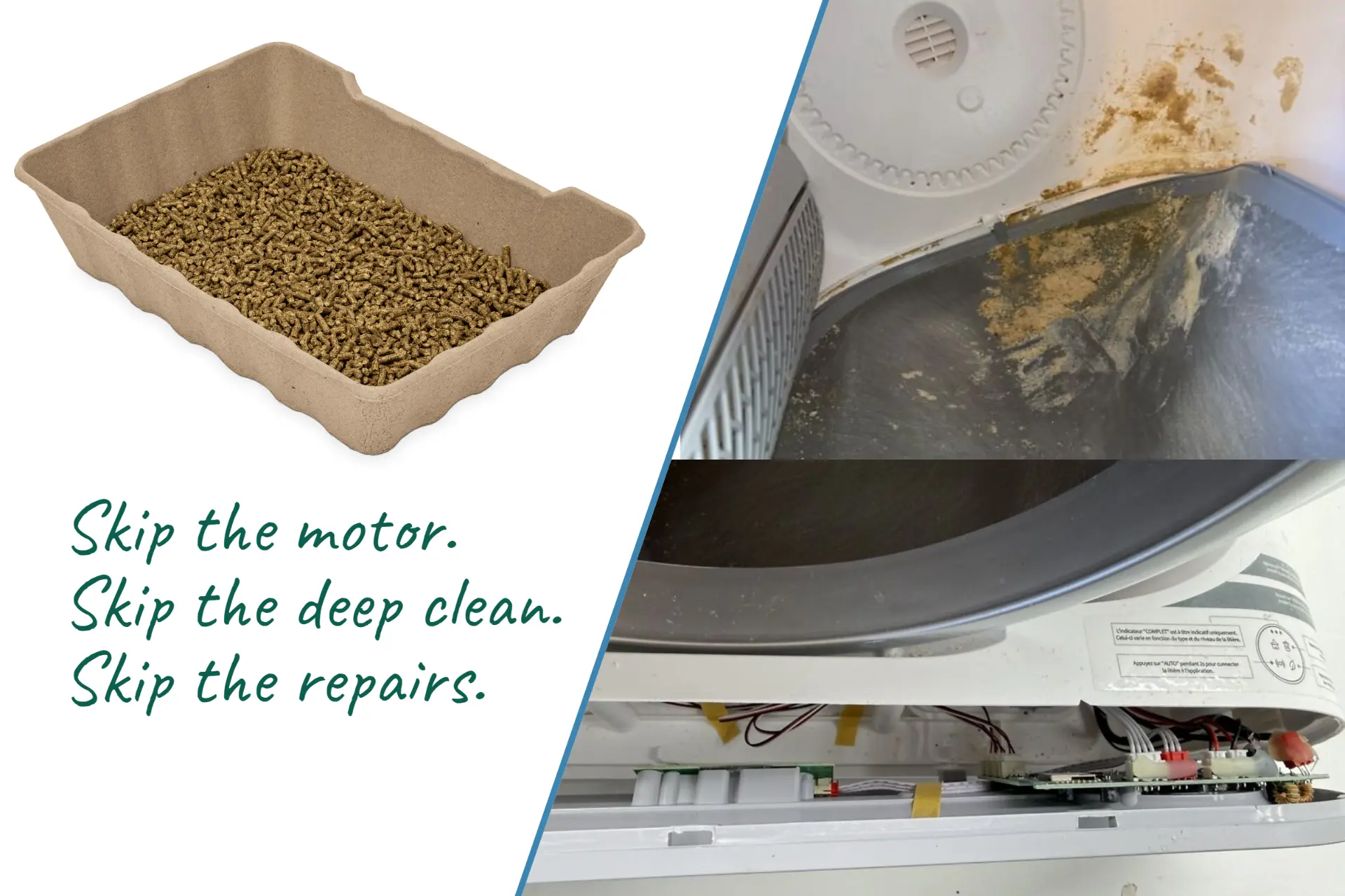
"An automatic litter box replaces daily scooping with monthly troubleshooting, cartridge subscriptions and, eventually, a broken plastic robot in landfill. A disposable tray replaces the whole surface — no motor, no app, no e-waste."
What an automatic litter box actually does
An automatic litter box is a plastic housing with a motor, sensors, a rake or a rotating drum, and a waste compartment. It detects when the cat leaves, waits, then sifts clumps into a sealed bag. The clean surface stays underneath. Premium units add Wi-Fi, weight tracking and app alerts. Entry models cost €150–250, mid-range €300–500, and top-tier automatic kitty litter pans €600–800 before accessories. A dedicated automatic option is automaticlittertray.com.
The pitch is 'never scoop again.' What it actually delivers is: no scooping most days, plus one longer weekly clean of the drum, sensor and waste bag, plus periodic troubleshooting when a clump wedges the rake or the sensor throws a false trigger. It reduces daily work; it does not remove work.
Where automatic litter boxes fall short
Cats often refuse them. The moving parts, the whirring motor and the enclosed drum are exactly the things sensitive cats avoid. Multi-cat households frequently discover that one cat uses it and the other quietly starts going next to it. Behaviourists commonly recommend keeping a regular tray as a backup — which cancels much of the point.
The cleaning does not disappear, it moves. You still empty the waste bag, wipe the drum, unclog the rake and descale sensors. Ammonia and biofilm settle into the plastic housing over months; scratches from grit trap odour just as they do in a normal plastic tub. By month twelve, most automatic boxes smell — you just cannot scrub the inside of a sealed motorised unit the way you can a simple tray.
Ongoing costs stack up. Proprietary waste bags, cartridges, filters and — in some brands — required subscription refills add €10–30 per month on top of the hardware. Motors, belts and sensors fail; warranty replacements are common in years two and three. When the unit finally dies, it becomes mixed plastic and electronics in a single bulky item that is not curbside-recyclable in most of Europe.
What a disposable tray does differently
EcoPetBox is a moulded-fibre tray made from recycled paper. No motor, no sensor, no app, no cartridge. You fill it with your preferred litter, use it for one to two weeks, then dispose of the whole tray in household waste or home compost — not in the paper recycling, because it is contaminated. A new tray comes out of the pack and the surface is at zero again.
That single mechanical difference solves the problems automatic boxes create. There is nothing to jam, nothing to charge, nothing to descale, nothing to update. The tray is the consumable; the surface never accumulates a year of ammonia because you are not keeping the surface for a year.
The daily routine is scoop-and-forget, exactly like a normal tray. The weekly routine is replace-the-tray — under a minute, no gloves, no scrubbing. There is no hardware to break, no subscription to cancel and no e-waste to dispose of when you eventually change setups.
Skip the motor, skip the deep clean
Everything an automatic box automates, it also complicates. Urine clumps bond to the plastic globe, so the weekly "quick wipe" turns into a 20–40 minute disassembly with soaking and scraping. The sifting mechanism only tolerates fine clumping clay — pellets, wood and silica jam it. The motor runs on your cat's schedule, which means grinding and beeping at 3am. Failure data from user reports and repair guides is consistent: roughly 22% electrical faults and 28% mechanical jamming inside 18–24 months, and budget units under €200 often go earlier.
A disposable tray removes the machine from the equation. Under 60 seconds to change, any litter type, silent day and night, nothing to repair, and it folds flat enough to travel in a tote bag instead of half a suitcase. Skip the motor, and the deep clean disappears with it — because you never keep the surface long enough for one to be needed.
The five-year cost math
A premium automatic box is not a €699 purchase, it is a €699 deposit. Add proprietary waste liners at roughly €15/month (€900 over five years), carbon filters and accessories (€120+), electricity for a unit that runs 24/7 (€50–80) and typical out-of-warranty repairs (€100–250). Realistic five-year ownership lands around €1,600–2,000.
The disposable side has no hardware line at all. Trays work out from about €4.86 each, roughly seven packs a year for one cat — around €102/year, so €100–180 over the same five years depending on how often you replace. No liners, no filters, no electricity, no repairs, no subscription.
That is a 10–20x difference in true cost, for a setup that takes less time per week rather than more.
The health signals an automatic box hides
Changing a tray by hand is not just maintenance — it is the most reliable home health check a cat owner gets. Blood in urine (early bladder disease and UTIs), soft stools or diarrhoea (parasites, food issues), reduced output (urinary blockage, life-threatening in male cats) and unusual colour or odour (kidney disease) are all visible in the tray and almost nowhere else. An automatic box removes the evidence before you ever see it, which is exactly why vets keep raising it.
There is a safety dimension too: sensor faults that trigger a cleaning cycle with the cat inside have caused documented injuries across several brands. No moving parts means no such failure mode.
Straight talk: a disposable tray is not perfect either. You buy trays regularly, you still scoop daily, and you still need to dispose of the tray in household waste or home compost rather than paper recycling. What you get in return is no electricity, no breakdowns, no e-waste, full visibility of your cat's health, and a change that takes under a minute.
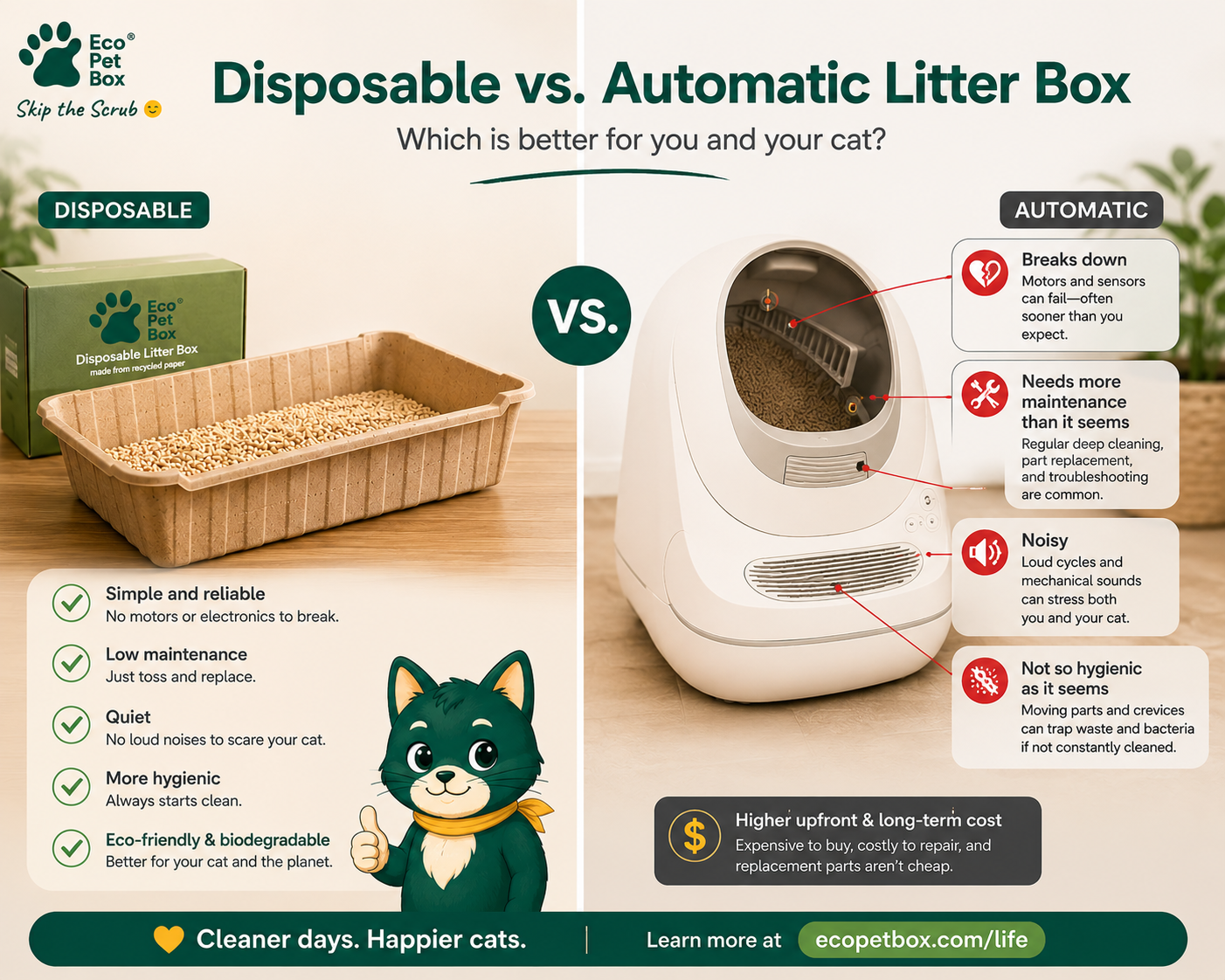
Automatic litter box vs disposable tray, side by side
Both replace daily scooping in some form. Here is what actually differs in a real household over three years.
| Factor | EcoPetBox disposable tray | Automatic litter box |
|---|---|---|
| Upfront cost | €6 per tray, no hardware | €150–800 hardware |
| Ongoing cost | Trays only, no subscription | Bags, cartridges, filters, sometimes required subscription |
| Daily work | Scoop, same as any tray | Scoop-free most days |
| Weekly work | Swap the whole tray in under a minute | Empty waste, wipe drum, unclog rake |
| Cat acceptance | Open tray, no noise, most cats accept immediately | Motor and enclosure put off many cats |
| Odour after 12 months | Reset every 1–2 weeks, no accumulation | Ammonia settles in plastic housing |
| Breakdowns | Nothing to break | Motors, sensors, belts fail |
| End of life | Household waste or home compost | 4–7 kg of mixed plastic and electronics |
| Power use | Zero | Continuous standby draw |
| Travel and backup | Grab a tray, done | Not portable |
When to choose which
- Choose a disposable tray if you want lower total cost, zero hardware risk and a fresh surface every 1–2 weeks
- Choose a disposable tray if your cat is anxious, elderly, or refuses enclosed litter boxes
- Choose a disposable tray if you value plastic-free, compostable pet care
- Consider an automatic box only if you are away long hours and your cat has already accepted a motorised unit at a friend's or shelter
- In multi-cat homes, keep at least one open disposable tray even if you own an automatic — behaviourists recommend it
- Never rely on a single automatic box as the only litter option — a stuck motor with no backup causes soiling within a day
Frequently asked questions
Is a disposable tray a good automatic litter box alternative?
Yes, for most households. It removes the same daily scooping problem an automatic litter box targets — you replace the tray itself every one to two weeks instead of scrubbing a plastic tub — without motors, sensors, subscriptions or e-waste.
Read the full articleDo cats prefer automatic kitty litter pans or open trays?
Most cats prefer open trays. Automatic boxes involve noise, movement and enclosed spaces, and a significant share of cats refuse them or start going next to them. Open disposable trays are the closest thing to the natural squat-and-cover behaviour cats already know.
Read the full articleHow much does an automatic litter box really cost per year?
Between €300 and €900 in year one once you add the unit, proprietary bags, cartridges, filters and any required subscription. A comparable year on a disposable tray runs roughly €150–200 total with no hardware to replace.
Read the full articleWhat happens to an automatic litter box at end of life?
It becomes 4–7 kg of mixed plastic housing, wiring and a motor — bulky electronic waste that is not curbside-recyclable in most of Europe. A used disposable tray goes to household waste or home compost.
Read the full articleCan I use a disposable tray as a backup for an automatic box?
Yes, and behaviourists commonly recommend it. Keep one open EcoPetBox tray in a second room so any cat that refuses the automatic unit, and any moment when the machine jams, is covered without soiling incidents.
Read the full articleRelated articles
 Related articles
Not ready to enquire yet? These may answer your question first.
August 17, 2026

Litter box liners: do they work — and what works better?
Read the full article: Litter box liners: do they work — and what works better?August 10, 2026
EcoPetBox vs Kitty Poo Club: which disposable litter box fits your life?
Read the full article: EcoPetBox vs Kitty Poo Club: which disposable litter box fits your life?July 1, 2026
Sifting vs disposable litter box: which saves you time?
Read the full article: Sifting vs disposable litter box: which saves you time?The simpler alternative to an automatic litter box
EcoPetBox replaces the tray, not the surface underneath it — no motor to jam, no app to update, no e-waste at the end. Try a set of three trays and see how a full weekly reset compares to a robot that never quite delivers.