Nachhaltigkeit
Gebaut, damit der Planet nicht für unsere Haustiere bezahlen muss.
Jede EcoPetBox-Schale, jeder Napf, jede Schaufel und jeder Beutel ist so konzipiert, dass sie sauber, natürlich und schnell wieder in die Erde zurückkehren, aus der sie stammen. So erhalten Besitzer mehr Freiheit von Plastik, Abfall und Schuldgefühlen.
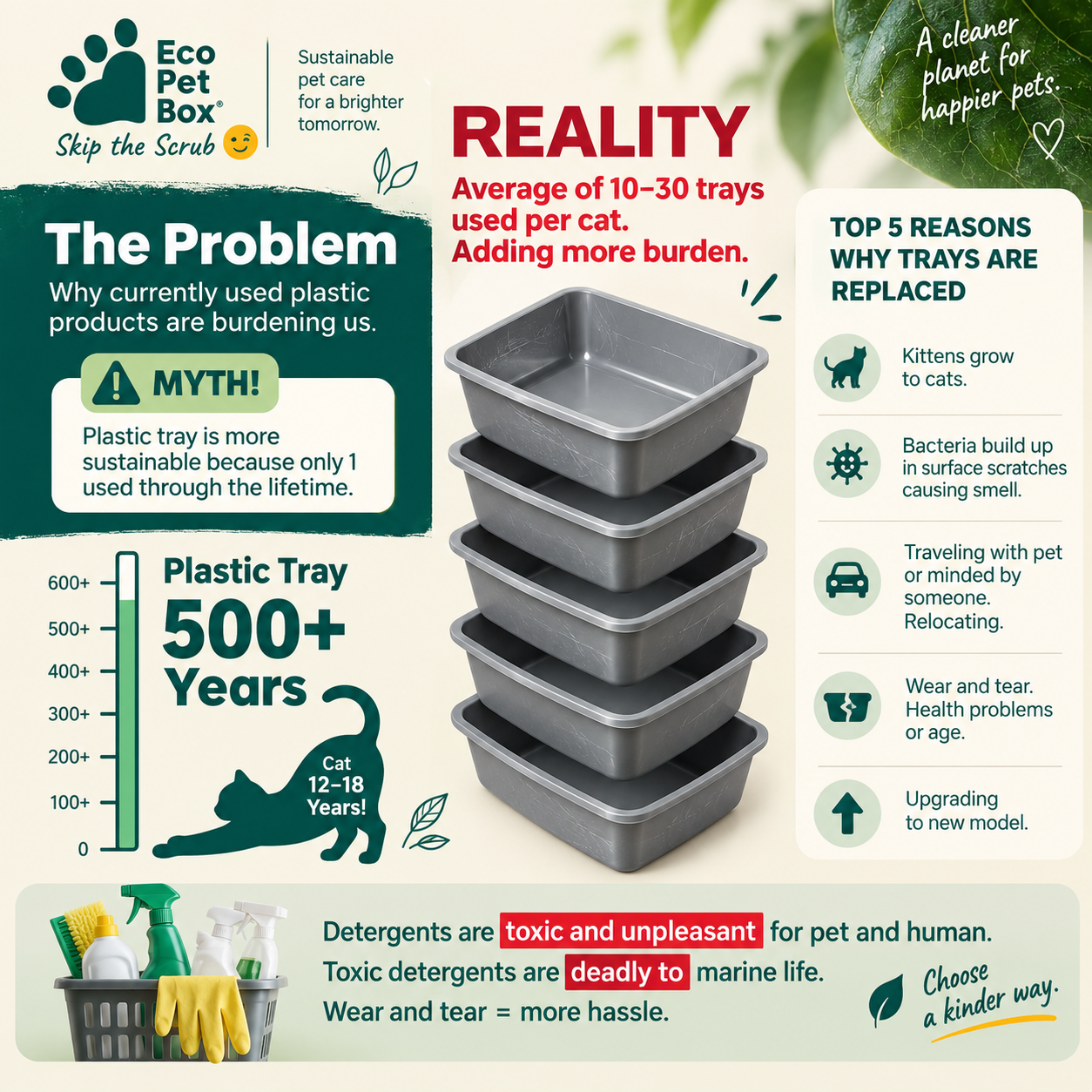
Der Mythos
„Eine Plastikschale hält ein Leben lang.“
In Wirklichkeit ersetzt der durchschnittliche Katzenbesitzer eine Plastikschale 10–30 Mal im Leben einer einzelnen Katze – wegen Bakterien in Oberflächenkratzern, Abnutzung, Geruch, Reisen oder einfach nur einem Umzug. Jede davon liegt dann über 500 Jahre auf der Mülldeponie.
Die Realität
Ein saubereres System, von Anfang bis Ende.
EcoPetBox-Schalen, -Näpfe, -Schaufeln und Komplettsets sind vollständig biologisch abbaubar in 3–6 Monaten. Unsere Streusorten sind ebenfalls biologisch abbaubar: Holz und Heu, reines Holz sowie Zuckerrohr- und Bambus-Mischung. Keine Reinigungsmittel, kein Waschwasser, keine Chemikalien – und PFAS-frei – für Katze, Besitzer und die Gewässer flussabwärts.
500+ Jahre
Plastikschale zum Abbau
3–6 Monate
EcoPetBox zum vollständigen biologischen Abbau
0 L
Waschwasser pro Jahr
600 000 L
Wasser eingespart pro 1.000 Haushalten/Jahr
Die Zahlen
97 % weniger CO₂ als jede Plastikalternative.
EcoPetBox ist 100 % recyceltes Papier – null Plastik, null Elektronik, null PFAS (Intertek-geprüft). Die Herstellung erzeugt 97 % weniger CO₂ als jede Plastik-Katzentoilette, ob automatisch oder nicht. Vollständig biologisch abbaubar in 3–6 Monaten.
vs. automatische Katzentoiletten
Plastik. Elektronik. Elektroschrott in 3–5 Jahren.
Automatische Katzentoiletten werden als Bequemlichkeit vermarktet. Was sie hinterlassen, sind 2–5 kg ABS-Kunststoffgehäuse, Leiterplatten, Motoren und Sensoren – als gefährlicher Elektroschrott eingestuft, sobald sie kaputt gehen. Nur 22 % des weltweiten Elektroschrotts werden formell recycelt; der Rest leitet Blei, Cadmium und Quecksilber über Jahrhunderte in das Grundwasser.
2–5 kg
ABS-Plastik pro Automatikbox
3–5 Jahre
Durchschnittliche Lebensdauer vor Ausfall
24/7
Netzstromverbrauch
vs. Einweg-Pipi-Pads
Plastikrückseite, SAP-Gel, Mülldeponie für 450 Jahre.
Einweg-Pipi-Pads kombinieren Plastikrückseite, Plastikfasern und superabsorbierendes Polymer (SAP)-Gel – nichts davon ist biologisch abbaubar. Eine Packung pro Woche erzeugt Hunderte von Pads pro Haushalt pro Jahr, die alle auf der Mülldeponie landen. Wiederverwendbare Stoffmatten lösen das Abfallproblem nur, indem sie ein weiteres hinzufügen: das Waschen von urindurchtränktem Stoff in Ihrer Haushaltsmaschine.
| Kategorie | Einweg-Pad | Wiederverwendbare Stoffmatte | EcoPetBox-Schale |
|---|---|---|---|
| Lebensende | Mülldeponie ~450 Jahre | Synthetisch – nicht biologisch abbaubar | Vollständig biologisch abbaubar in 3–6 Monaten |
| Materialien | Plastik + SAP-Polymer | Plastikfasern + Beschichtung | 100 % recycelter Karton |
| PFAS / Chemikalien | Polymergel, Lockstoffe | Synthetische Imprägnierung | Null – Intertek-zertifiziert |
| Wasserfußabdruck | Keiner – aber Einweg | Wöchentliche Maschinenwäsche | Kein Waschwasser |
Vergleich des Fußabdrucks
EcoPetBox vs. Plastik-Katzentoilette.
| Kriterien | EcoPetBox | Plastikschale |
|---|---|---|
| Erneuerbarkeit | Sehr gut | Sehr schlecht |
| Herstellungs-Fußabdruck | Niedrig | Hoch |
| Lebensende | Vollständig biologisch abbaubar in 3–6 Monaten | Mülldeponie 500+ Jahre |
| Benötigte Chemikalien zur Reinigung | Keine | Reinigungsmittel & Desinfektionsmittel |
| Risiko der Bakterienansammlung | Keine – jedes Mal frisch | Hoch – Kratzer beherbergen Bakterien |
Ein kleiner Wechsel in Ihrem Regal. Eine große Veränderung für den Planeten.
KontaktCompliance & certifications
Third-party tested. Retail-ready.
EcoPetBox trays are independently audited and lab-tested against the standards buyers and regulators ask for. Full test reports and certificates are available to verified retail and distribution partners on request.
FSC® Chain of Custody certified
Manufactured under a Bureau Veritas–audited FSC Chain of Custody scheme covering FSC 100%, FSC Mix and FSC Recycled fibre. Renewable, traceable material — never virgin plastic.
PFAS-free
Independently tested by Intertek against EN 17681-1 for perfluoroalkyl and polyfluoroalkyl substances. PFOS, PFOA and related compounds: not detected. Total fluorine below the 20 mg/kg screening threshold.
FDA food-contact tested
Molded fibre tested by TÜV Rheinland to US FDA 21 CFR 176.170 (paper and paperboard in contact with aqueous and fatty foods). Result: Pass.
RoHS compliant
Tested by TÜV Rheinland to Directive 2011/65/EU as amended by (EU) 2015/863. Lead, cadmium, mercury, hexavalent chromium, PBBs, PBDEs and the four regulated phthalates: not detected.
EU Packaging & Packaging Waste compliant
Meets the heavy-metal sum limits of Directive 94/62/EC and the US Toxics in Packaging Clearing House (TPCH) model. Made from 100% recycled paper fibre.
Halogen-free
Bromine, fluorine and iodine content: not detected (EN 14582). No halogenated flame retardants, no PFAS coatings, no chlorinated bleaches on the finished tray.
Registered EU trademark & design
EcoPetBox / ECO PET BOX is a registered trademark in the European Union and the United States (USPTO Principal Register). Our molded-fibre litter tray is a Registered Community Design at EUIPO and a Registered Design at the UK IPO, both protected through 2029. Retail-safe IP for distributor and private-label partners.
Global manufacturing footprint
Production across Estonia, Thailand, China, Mexico and Poland — dual-source resilience, shorter lead times to EU and North American DCs, and consistent audited quality standards.
Testing partners include TÜV Rheinland, Intertek and Bureau Veritas. Certificates, registration numbers and test report references are shared under NDA with qualified B2B partners.
Life Cycle Assessment · June 2026
The numbers, verified.
In June 2026 we published a full Life Cycle Assessment of the EcoPetBox molded-fibre litter tray and food & water bowl, prepared using recognised lifecycle analysis methodology. It covers raw materials, manufacturing energy, transport, use and end-of-life — the same framework used by leading food and packaging brands for their independent climate claims.
0.0525
kgCO₂e per tray — factory gate
0.1262
kgCO₂e delivered to the EU (cradle-to-customer)
~97%
less carbon than a plastic litter tray
~9×
lower carbon than a standard pee pad (single use)
98.7%
of manufacturing carbon is process electricity
2–4 mo
to biodegrade when composted (under 1 yr in landfill)
Where the carbon comes from
98.7% of manufacturing carbon is process electricity (pulping, forming, drying, hot-pressing, cutting). Local transport contributes 1.3%. Water use is under 0.1% — the same 10,000 L are filtered and reused across 25–30 batches. Raw material impact is near zero: every fibre comes from a waste stream (old corrugated cardboard, post-industrial scrap, waste-paper flakes). No trees are cut for EcoPetBox.
End of life
Recycle, compost, or biodegrade naturally: under 1 year in landfill, 2–4 months when composted. Zero plastic content, PFAS not detected (Intertek EN 17681-1), FDA 21 CFR 176.170 pass for food/water contact, and FSC Chain of Custody audited by Bureau Veritas.
Certifications FAQ
Quick answers on testing, compliance and IP.
The most common questions we get from buyers, distributors and private-label partners about how EcoPetBox trays are tested and protected.
Are EcoPetBox products certified and third-party tested?
Yes. Our molded-fibre trays are independently tested and certified by TÜV Rheinland, Intertek and Bureau Veritas against FDA 21 CFR 176.170 (food-contact), EN 17681-1 (PFAS), RoHS 2011/65/EU as amended by (EU) 2015/863, EN 14582 (halogens), FSC Chain of Custody, and EU Directive 94/62/EC on packaging waste.
Is EcoPetBox really PFAS-free?
Yes. PFOS, PFOA and related perfluoroalkyl compounds were not detected in independent Intertek testing to EN 17681-1. Total fluorine sits below the 20 mg/kg screening threshold — there are no PFAS coatings on the finished tray.
Are the trays safe for food and water contact?
Yes. The molded fibre passed TÜV Rheinland testing to US FDA 21 CFR 176.170, covering paper and paperboard in contact with aqueous and fatty foods. That is the same standard used for takeaway food packaging.
What about heavy metals and restricted substances?
Lead, cadmium, mercury, hexavalent chromium, PBBs, PBDEs and the four regulated phthalates were not detected in RoHS testing. The trays also meet the heavy-metal sum limits of EU Directive 94/62/EC and the US TPCH model on packaging.
Is the brand and product design legally protected?
Yes. EcoPetBox / ECO PET BOX is a registered trademark in the European Union and on the USPTO Principal Register in the United States. Our molded-fibre litter tray is a Registered Community Design at EUIPO and a Registered Design at the UK IPO, both protected through 2029 — retail-safe IP for distributor and private-label partners.
How do partners access certificates and test reports?
Full certificates, registration numbers and test report references are shared under NDA with qualified retail and distribution partners. Email partner@ecopetbox.com and we'll send the compliance pack for your market.