
Materials
Why Your Plastic Litter Tray Gets Worse Every Month
Most cat owners assume a plastic litter tray is a one-time purchase that lasts years. It isn't. From the day you take it out of the packaging, it starts a slow, invisible decline that your cat notices long before you do — and the way most owners respond to it makes the problem worse.
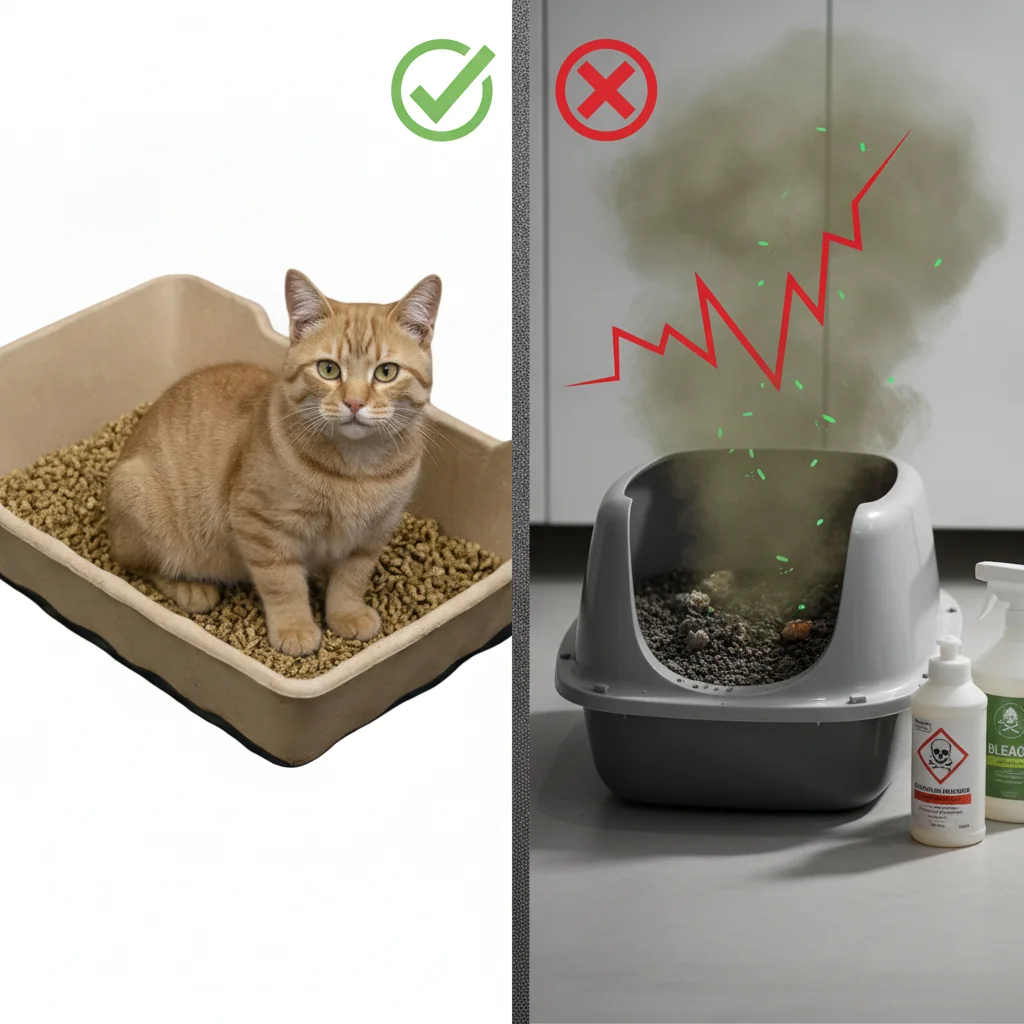
"Your plastic tray isn't cheap because it lasts. It's cheap because it stops delivering what you bought it for — and hides the fact from you."
The scratches you can't see
Cat claws plus weekly scrubbing equals microscratches within weeks. Every dig, every scoop, every pass with a stiff brush leaves fine grooves in the polypropylene. They're rarely visible under normal room light — you usually need an angled beam or a magnifier to see them at all.
That's why the standard household inspection ("looks clean, smells clean") gives owners a false all-clear. The surface has already changed. The tray you're looking at is not the tray you bought.
What lives in the scratches
Bacterial colonies establish inside those microgrooves and build biofilm — a chemically bonded matrix of microorganisms and proteins that ordinary household detergents cannot dissolve. You can scrub the smooth surface clean and leave the biofilm inside the scratches completely intact.
Biofilm keeps working after you've closed the bathroom door. It off-gasses ammonia and volatile sulphur compounds continuously. That's why the smell comes back faster after each clean, even when the litter itself is fresh.
The doom loop
Owner smells the ammonia. Scrubs harder. The harder scrub creates more microscratches. Biofilm re-establishes faster in the fresh grooves. The smell returns even quicker. Owner reaches for bleach or a stronger disinfectant. Chemical residue lingers on the plastic. The cat's nose reads the residue as "not safe" and starts avoiding the tray.
The owner interprets the avoidance as "the tray must be dirty" — and cleans harder still. Every step in the loop is a rational response to the previous step. The loop itself is the problem, and plastic is what makes the loop possible.
What the "€7 tray lasts years" claim really means
The tray physically exists for years. It doesn't crack, it doesn't leak, it holds litter. On a shelf it is indistinguishable from the day you bought it. The household experience of the tray, however, degrades month over month: more scrubbing, faster smell return, more rejection, more chemical use.
There's a difference between a product that lasts and a product that keeps delivering. Cheap plastic trays confuse the two, and the cost shows up in your time, your bathroom air quality, and eventually in the litter box your cat quietly stops using.
Why this doesn't happen with disposable pulp trays
Every replacement cycle starts with a fresh, un-scratched, biofilm-free surface. There is nothing to scrub, so there are no scrubbing scratches. There is no petroleum-plastic pore structure to hold ammonia. There is no chemical residue from disinfectants because you don't need to disinfect a tray you're about to compost.
The clock resets. That is the entire point of a moulded recycled-paper tray, and it's the one thing plastic — recycled or virgin — can't offer.
The plastic-tray doom loop, in one glance
- Weeks of use → microscratches invisible to normal inspection
- Scratches host biofilm that household detergents cannot remove
- Biofilm off-gasses ammonia and sulphur compounds between cleans
- Owner scrubs harder → more scratches → faster smell return
- Stronger disinfectants leave residue that cats reject
- Rejection is misread as "dirty" — cleaning intensifies
Domande frequenti
How often should I replace a plastic litter tray?
Most vets and hygiene guides suggest replacing a plastic tray every 6–12 months, and sooner if you can see scratches or smell ammonia after a full clean. In practice many owners keep them for years without realising the biofilm story below the surface.
Why does my cat's litter tray smell even right after I clean it?
Because scrubbing removes surface contamination but not the biofilm inside microscratches. That biofilm keeps releasing ammonia and sulphur compounds continuously. On a scratched plastic tray, the smell begins returning within hours.
Can bleach fix a scratched plastic litter tray?
It reduces bacterial load temporarily but doesn't remove biofilm from inside the scratches, and it leaves chemical residues on the plastic that many cats then avoid. Replacing the tray (ideally with a disposable, fresh-every-cycle option) is the only real fix.
Articoli correlati
 Articoli correlati
Non sei ancora pronto a scriverci? Questi articoli rispondono spesso alle domande più frequenti.
July 2, 2026

La scienza dell'odore nella vaschetta: perché alcuni materiali lo trattengono
Leggi l'articolo completo: La scienza dell'odore nella vaschetta: perché alcuni materiali lo trattengonoJuly 2, 2026
Perché produciamo lettiere in carta riciclata — non in plastica
Leggi l'articolo completo: Perché produciamo lettiere in carta riciclata — non in plasticaJuly 2, 2026
Perché i gatti preferiscono le lettiere di carta alla plastica — e cosa ti sta dicendo il tuo gatto
Leggi l'articolo completo: Perché i gatti preferiscono le lettiere di carta alla plastica — e cosa ti sta dicendo il tuo gattoReset the clock every cycle
See the EcoPetBox disposable recycled-paper trays — a fresh, biofilm-free surface every time, no scrubbing, no bleach, no cat rejection.