
Materials
The Science of Litter Tray Odour — Why Some Materials Trap It and Others Reflect It
Every litter tray has to answer one question: where does the smell go? The answer depends entirely on what the tray is made of — and it's the single biggest reason some trays feel manageable in a small flat and others make you want to move house.
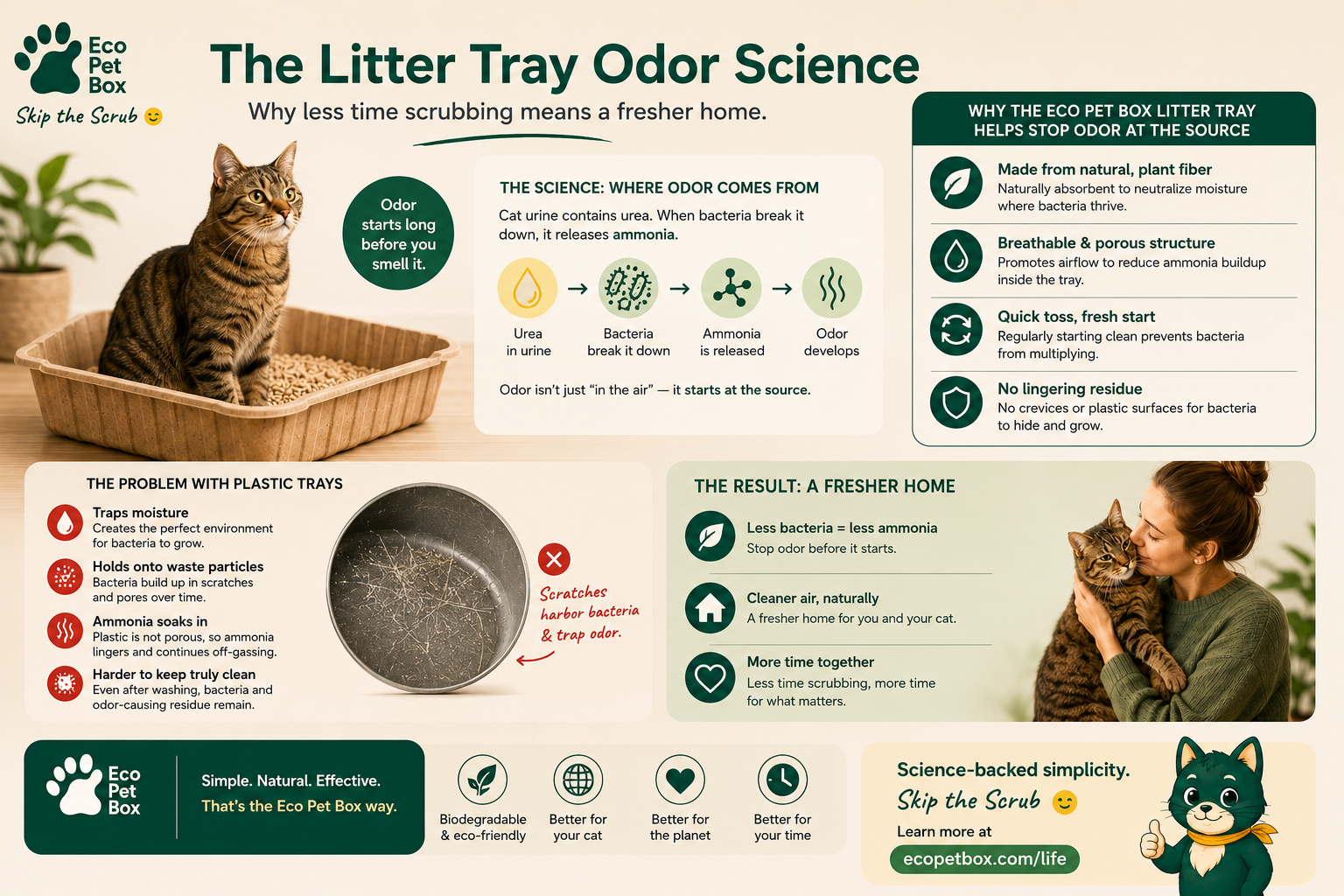
"The only litter tray that absorbs odour at the material level. No coatings, no fragrances, no plastic in disguise."
Three materials, three answers
Plastic is non-porous. Nothing absorbs. Every ammonia molecule and volatile sulphur compound released by fresh urine stays in the ambient air of the room until you open a window. The tray is essentially a mirror — it reflects the smell straight back at you.
Laminated cardboard (the cheap disposable trays on Amazon) is coated. The coating traps liquid at the surface and then re-releases odour back into the air as it warms. It behaves almost identically to plastic — it's plastic wearing a paper costume, with a shorter working life.
Uncoated pressed pulp is porous. Volatile compounds are drawn into the fibre structure and held there. Our proprietary pressing process keeps the tray liquid-proof without adding a coating, so the odour absorption stays intact for the full replacement cycle.
Why "liquid-proof and breathable" is the engineering that matters
Almost every disposable tray on the market solves liquid-proofing the easy way: a plastic or wax layer bonded to the pulp. That layer stops leaks — and it stops odour absorption at the same time. Owners get a tray that behaves like a paper-shaped plastic box.
EcoPetBox is one of very few products (the only one we're aware of at commercial scale) engineered to be liquid-proof and breathable at the same time. The pressing, not a coating, is what makes it hold water. That's what allows the fibre to keep absorbing ammonia while the tray is in service.
Why your cat notices before you do
A cat's olfactory sensitivity is roughly fourteen times higher than a human's. Ambient ammonia levels that a person barely registers read to a cat as a chemical warning. This is why cats reject "clean-looking" trays — they can smell what you can't.
Once you understand that, the behaviour patterns line up with the material physics. A plastic or laminated tray that seems fine to you is loud to the cat. A porous fibre tray that has quietly absorbed the day's ammonia reads to the cat as neutral.
Why fragranced sprays and baking soda make it worse
Fragrance additives don't remove ammonia — they add a second, stronger scent for the cat to react to. Baking soda absorbs a little at the litter layer but does nothing about a scratched, off-gassing plastic tray underneath. You're covering a symptom, not addressing where the odour is coming from.
The only real fix is to put the odour management into the tray itself, at the material level, so it happens automatically for the full cycle with no additives.
What real absorption feels like in daily use
The clearest signal is time. Owners repeatedly report no perceptible smell after three weeks of daily single-cat use — no sprays, no baking soda, no scented litter. That's not marketing language; it's what porous pulp with no coating actually does when the engineering is right.
It also changes the room. You stop noticing where the litter tray is. That's the practical difference between a material that traps odour and one that reflects it.
How each material handles odour
- Plastic: non-porous — reflects ammonia into the room
- Laminated cardboard: coated — traps at surface, then re-releases
- Coated fibre: paper on the outside, plastic on the inside
- EcoPetBox pressed pulp: porous and liquid-proof — absorbs into the fibre
- Fragrance sprays: add a second scent, don't remove ammonia
- Baking soda: helps the litter, ignores the tray itself
Preguntas frecuentes
What is the best material for a cat litter box?
For odour control, an uncoated pressed-pulp tray is the only material that absorbs volatile compounds into its structure. Plastic reflects them; laminated cardboard traps and re-releases them; fragranced options mask them.
How can I stop my cat's litter box from smelling?
Stop adding scents and start looking at the tray. If the tray itself is non-porous or coated, no litter or additive will fully fix the ambient ammonia. A porous, uncoated fibre tray removes the odour at source.
Is cardboard better than plastic for a litter box?
Only if the cardboard is uncoated and engineered to stay liquid-proof without a plastic or wax layer. Standard laminated cardboard trays behave like plastic on odour and fail on leaks within days.
Artículos relacionados
 Artículos relacionados
¿Aún no te decides a escribirnos? Estos artículos suelen responder las dudas más frecuentes.
July 2, 2026
Por qué tu arenero de plástico empeora cada mes
Leer el artículo completo: Por qué tu arenero de plástico empeora cada mesJuly 2, 2026

Por qué fabricamos areneros de papel reciclado — no de plástico
Leer el artículo completo: Por qué fabricamos areneros de papel reciclado — no de plásticoJuly 2, 2026
Por qué los gatos prefieren los areneros de papel al plástico — y qué te dice tu gato
Leer el artículo completo: Por qué los gatos prefieren los areneros de papel al plástico — y qué te dice tu gatoAbsorption at the material level
EcoPetBox is engineered to be liquid-proof and breathable — no coating, no plastic, no fragrance. Just the material doing the work.