
Home use comparison
Disposable pads. Washable pads. Or the plastic-free tray. What's left of 10 years of use, centuries later?
All three products solve the same problem — absorbing pet mess at home — but they differ enormously in what they are made of, how many times they are used, and what happens after. This is a material, hygiene, and long-term waste comparison for pet owners: disposable pee pads vs washable pee pads vs the EcoPetBox biodegradable, plastic-free tray system. Figures are modelled from brand-stated durability claims and published research on laundering and pathogens — assumptions are noted in each section.
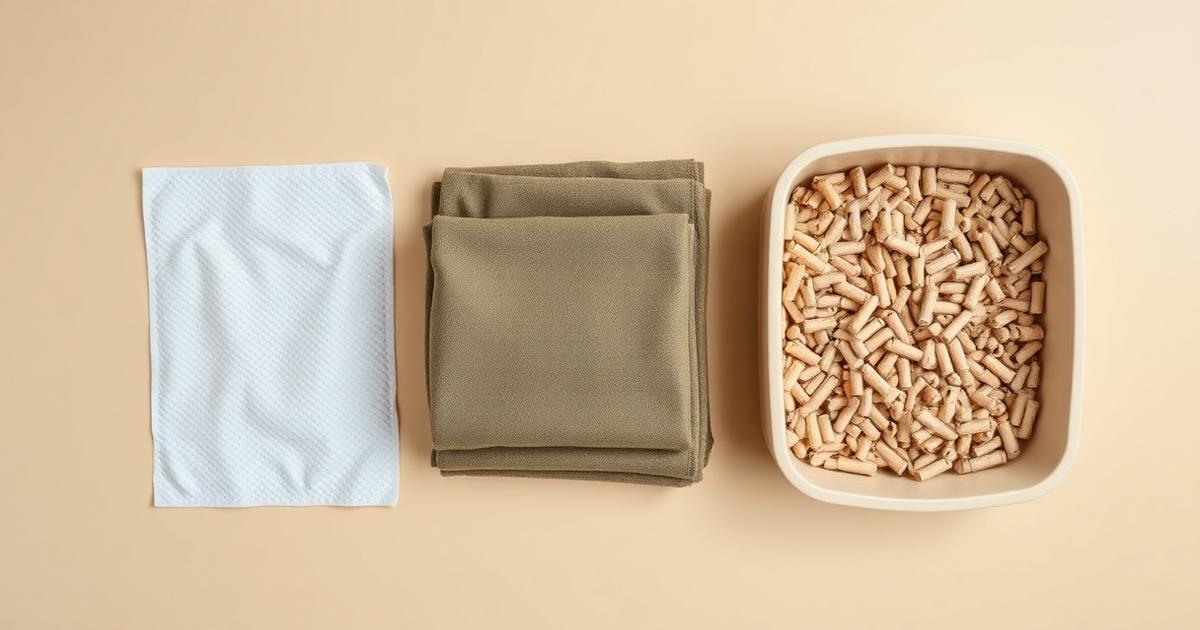
"Reusable quietly converts a landfill problem into a recurring water, energy, and pathogen-handling problem — one that most sustainability comparisons never price in."
The three products, side by side
A disposable pee pad is a single-use plastic composite: a plastic backing, a super-absorbent polymer (SAP) core, and a nonwoven top sheet. It is sealed, binned, and sits in landfill for roughly 500 years. It carries no wastewater exposure and no home cleaning burden beyond disposal — its cost is pure accumulation.
A washable pee pad is a multi-layer synthetic textile: a polyester top layer, an absorbent pulp or mesh core, a PUL or TPU waterproof barrier, and a polyethylene base. Manufacturers rate them for roughly 200–300 washes (up to about 1,000 for premium brands), which is around 2–4 years per pad at typical home use. It does not meaningfully biodegrade — the synthetic layers are the same order of magnitude as plastic.
The EcoPetBox tray is a single-material moulded recycled paper tray used with a natural wood litter. A set of three trays covers about one month, or up to two months if trays that are still in good condition are reused. It is PFAS-free, plastic-free, and fully biodegrades in 3–6 months in household waste or home compost.
What washing a pad actually costs
Washing is where the reusable option quietly stops being cheap. A washable pad kept in daily-ish rotation is realistically washed about 110 times a year (washing every 2–3 uses at a blended ~0.75 pad-uses per day). A modern high-efficiency machine uses 26–50 litres of water per load; an older top-loader can use up to 151 litres. That works out to roughly 2,900–16,600 litres of water per pad per year, or 29,000–166,000 litres over ten years — for a single pad.
Electricity is the same story. A wash cycle uses 0.5–1.5 kWh, and around 80% of that energy heats the water. Over ten years that is roughly 550–1,650 kWh per pad. The disposable pad and the EcoPetBox tray carry none of this recurring load — after purchase, the resource cost is zero.
Then there is the microplastic legacy. Using the published estimate that a typical polyester laundry load sheds around 700,000 fibres per wash, one washable pad run ~110 times a year for 10 years releases on the order of 770 million microplastic fibres into wastewater. That is an order-of-magnitude illustration, not a lab measurement of one specific pad, but the scale is the point. Once shed, those fibres are already in rivers, soil and sediment — most are too small for wastewater treatment to capture, they do not biodegrade, and they fragment into ever smaller nanoplastics that persist for centuries.
The hygiene story most comparisons skip
US CDC guidance is explicit: items with visible urine, faeces or blood should be washed as a separate, pre-treated load — not mixed with regular laundry — because these stains carry heavy bacterial and parasitic loads. Reliable pathogen kill needs at least 60°C (140°F), which is exactly the cycle that consumes the most electricity. Cold and 'quick' cycles, the energy-saving choice, are also the cycles least likely to neutralise what is actually on the pad.
Hand-washing is not a safer alternative. It means direct skin and mucous-membrane contact with urine-borne bacteria and parasites during the wash, no reliable high-heat kill step, and post-wash hygiene that needs a full 40–60 second hand-wash — alcohol-based sanitiser alone does not work against parasite oocysts.
Several common pet parasites are engineered to survive normal cleaning. Toxocara canis (roundworm) eggs survive more than two years in the environment and resist formalin, Lysol, chlorine, phenol and quaternary ammonium compounds. Giardia and Cryptosporidium cysts are highly chlorine-resistant — complete Cryptosporidium inactivation can require chlorine doses far above what is used in wastewater treatment. Bleach works, but bleach is also the ingredient most likely to cause skin irritation on pet skin, which is roughly ten times thinner than human skin. There is no clean answer: effective disinfection and gentle-on-skin sit in direct tension. Disposable pads and EcoPetBox trays never create this wash pathway at all — there is no cycle, so there is no fibre release, and no contaminated wastewater going down the drain.
Three households, three realistic pictures
The apartment puppy owner during a 6-month training phase uses a pad roughly once a day. That is about 180 disposable pads binned, or a single washable pad run through 70+ wash cycles (each shedding microplastic fibres into the building's wastewater), or around six EcoPetBox tray sets — 18 trays if not reused, as few as 9 if every tray is reused to its full two-month extension — all of which fully compost within a season.
The senior dog with daily incontinence needs is the long-tail case. Daily use for years means about 365 disposable pads a year, all landfilled. Washable users would replace a pad every couple of years and run roughly 1,400+ wash cycles across a decade — a lot of detergent, hot water and cumulative microplastic release for one dog. EcoPetBox would run at 18–36 trays a year (1.5 to 3 sets a month depending on reuse), none of which persist past a few months.
The multi-pet household with a cat and a small dog is the flexibility case. Mixed species and irregular frequency mean disposables pile up unpredictably and washables sit around damp between washes. EcoPetBox works across cats, dogs and small pets with the same system, and a rotating supply scales to whichever animal needs it that week — with no dedicated laundry routine.
Year 10: stop. Then what?
Model one household, one dog, ten years of daily use at 1 use/day — and then no more units are ever added. Everything after year 10 is simply asking: what does that decade of use leave behind, decades and centuries later?
At the year 10 cut-off, there are about 3,650 disposable pads in landfill, roughly 5 washable pads worn out or discarded, and about 2–3 EcoPetBox trays still finishing their 3–6 month decomposition. Twenty years after the stopping point (year 30), the disposable pile is unchanged, the washable pads are still there because synthetic textile blends do not have a defined biodegradation endpoint in a human-relevant timeframe, and the EcoPetBox trays are gone.
One hundred years after the stopping point (year 110), disposable pads are still roughly 78% short of their ~500-year decomposition point. Three hundred years after the stopping point (year 310), they are still ~38% short of full decomposition. The last EcoPetBox tray put into use at the year 10 cut-off finished decomposing about six months later — at year 310, it has been back in the soil for approximately 299.5 years. And the microplastic fibres already released by year 10 are still out there at every one of those checkpoints too — arguably in more places, in smaller and more bioavailable pieces, not fewer.
The five metrics at a glance
Same job, three very different footprints. The EcoPetBox tray is the only option that starts as one material, biodegrades on a human-relevant timescale, and adds nothing to the wastewater system.
| Metric | EcoPetBox tray | Pads (disposable or washable) |
|---|---|---|
| Materials involved | 1 — moulded recycled paper | 3 for disposable (plastic, SAP, nonwoven); 4+ for washable (polyester, pulp, PUL/TPU, PE) |
| Biodegrades? | Yes, in 3–6 months | Disposable: no (~500 years). Washable: no, synthetic blends fragment into microplastic |
| Wastewater and microplastic burden | None — no wash cycle exists | Washable: yes, every wash. Disposable: none, but landfill only |
| Pet skin and allergy risk | Low — PFAS-free, no detergent contact | Washable: moderate, detergent residue on thin pet skin |
| Ongoing resource cost | Purchase only — zero water, energy or detergent | Washable: water, electricity, detergent every wash. Disposable: purchase only, but permanent landfill |
Why the plastic-free tray wins the 10-year picture
- One material — moulded recycled paper — instead of 3–4 fused layers of plastic and synthetic textile
- Fully biodegrades in 3–6 months in household waste or home compost
- Zero wash cycles, so zero water, electricity and detergent burden after purchase
- No microplastic fibre shedding into rivers, soil or the food chain
- PFAS-free surface, no bleach or hot-wash needed to reset hygiene
- Works for cats, dogs and small pets — one system across the household
Preguntas frecuentes
Are washable pee pads really more sustainable than disposables?
Only if you ignore the recurring costs. Washables trade a landfill problem for a decade of hot-water washes, detergent, electricity and microplastic shedding. The pad itself also does not biodegrade meaningfully — the synthetic layers persist. Over ten years of daily use, that becomes thousands of litres of water and hundreds of millions of microplastic fibres for a single pad.
Isn't the EcoPetBox tray still 'more waste' because you use several trays per month?
No, because the material and the timescale are different. A set of three trays is one to two months of use, and every used tray fully biodegrades in 3–6 months in household waste or home compost. Even at maximum use — around 36 trays a year — nothing from that year is still around at year 20, whereas every disposable pad and every washable pad from that same year still is.
How should I dispose of a used EcoPetBox tray?
Dispose of it in general household waste or home compost, together with the used natural litter. Do not put it in paper recycling — used pet-care paper is contaminated and should not be recycled further. The tray will fully biodegrade in 3–6 months.
Does the tray work for dogs and small pets, not just cats?
Yes. The same moulded recycled paper tray works for cats, small dogs (especially in the training phase or with senior incontinence needs), and small pets like rabbits. That is why the multi-pet household in the comparison uses one system instead of stocking pads plus a plastic litter tub.
What about microplastics from a washable pad — is 770 million fibres a real number?
It is an order-of-magnitude estimate, not a lab measurement of one specific pad. It combines the published finding that a typical polyester laundry load sheds around 700,000 fibres per wash with roughly 1,100 washes over a decade of daily-ish use. The exact figure varies by fabric and machine, but the scale — hundreds of millions of persistent fibres per pad over ten years — is consistent with the peer-reviewed literature on microfibre pollution.
Artículos relacionados
 Artículos relacionados
¿Aún no te decides a escribirnos? Estos artículos suelen responder las dudas más frecuentes.
July 13, 2026

El pañuelo de papel del futuro: por qué las bandejas desechables sustituirán las de plástico
Leer el artículo completo: El pañuelo de papel del futuro: por qué las bandejas desechables sustituirán las de plásticoJune 20, 2026
Análisis de ciclo de vida — las cifras de CO₂ de EcoPetBox 2026
Leer el artículo completo: Análisis de ciclo de vida — las cifras de CO₂ de EcoPetBox 2026October 12, 2026

Bolsas para el arenero: qué tipo elegir y cuándo no necesitas ninguna
Leer el artículo completo: Bolsas para el arenero: qué tipo elegir y cuándo no necesitas ningunaSkip the wash cycle. Skip the 500-year pad.
Order an EcoPetBox set and see how quickly plastic tubs and wash-heavy pads become optional at home.